10 Power Inverter Buying Tips for Global Buyers
A Power Inverter can look simple on a product page: a metal case, two sockets, and a confident wattage claim. The real buying decision is more detailed. Buyers need to match the inverter to the equipment, battery, installation, and local operating conditions. A refrigerator may draw much more power when its compressor starts than it uses while running. That brief surge matters.
Power-electronics specialist Daniel Mercer puts the principle plainly: “Choose for the load you actually have, not the number that looks impressive.” Treat that as a useful buying rule, not a substitute for checking the manufacturer’s specifications. Compare continuous output with peak surge capacity. Confirm the DC input voltage, output waveform, protection features, cooling method, and connection requirements. A pure sine wave model may suit sensitive electronics, but suitability depends on the device and its manufacturer’s guidance.
This guide’s ten tips help global buyers ask sharper questions before comparing prices. Check efficiency under realistic loads, not only headline figures. Review certifications and documentation applicable to your destination, and confirm service support, warranty terms, and spare-part access. Ask how the unit behaves in a hot, dusty room or a vehicle with limited airflow. Small details count. A short cable, unclear labeling, or missing support contact can complicate installation. And one honest caveat: published ratings do not tell the whole story. Request test conditions where possible, then compare like with like. A careful choice takes more work. It can prevent an expensive mismatch.
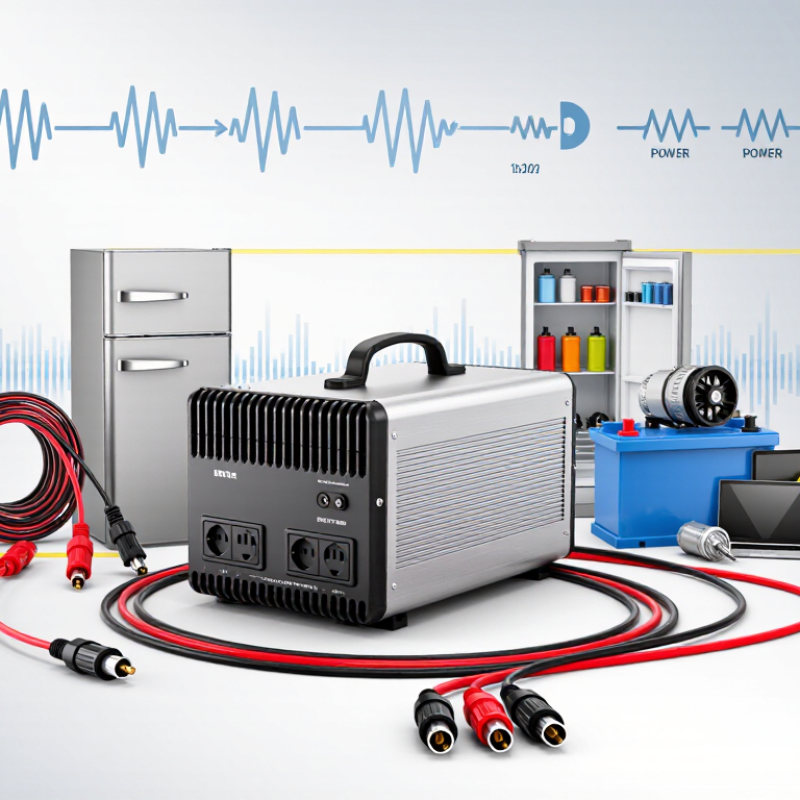
Calculate Continuous and Surge Capacity for the Connected Load
For a reliable inverter choice, size two different demands: the load that runs continuously and the brief surge needed at startup. List each device’s running watts from its nameplate, then add only loads expected to operate together.
The U.S. Energy Information Administration’s 2020 Residential Energy Consumption Survey reports average household electricity use of about 10,600 kWh per year. That annual figure describes energy, not peak power, so it cannot determine inverter capacity by itself.
Real loads misbehave.
For example, a pump drawing 500 W while running and 1,500 W at startup, alongside 300 W of other active loads, needs about 800 W continuously and 1,800 W during startup. These are example values; check the pump’s label or manufacturer documentation. Confirm that the inverter supports the surge for the required duration, not merely a higher peak number for an unspecified instant. If two motors may start together, add their startup demands. If they cannot, document the operating sequence instead of oversizing by guesswork. Leave reasonable headroom, and check any continuous-output derating for temperature or altitude in the inverter’s technical specifications. I still verify the actual load list on site; nameplates can miss what a system really runs.
Match DC Input Voltage to a 12 V, 24 V, or 48 V Battery Bank
Match the inverter’s DC input to the battery bank’s nominal voltage: 12 V, 24 V, or 48 V. These are not interchangeable settings. A 1,200 W load draws about 100 A at 12 V, 50 A at 24 V, or 25 A at 48 V, before conversion losses. Higher current requires careful cable sizing, secure terminals, and suitable overcurrent protection. A warm cable or a voltage drop during startup is a warning, not a minor inconvenience. Check the inverter’s permitted input range, low-voltage cutoff, and surge rating against the battery specifications.
Capacity alone is not enough. Confirm that the battery’s charging limits and protection system are compatible with the inverter and any charger in the setup. The 2019 PNNL report Energy Storage Technology and Cost Characterization Report uses about 85% round-trip efficiency as a lithium-ion storage benchmark. That figure describes stored-and-returned energy, not an individual inverter’s efficiency, and real results vary with operating conditions. It is easy to focus on the headline voltage and miss the cutoff settings. That part deserves a second look. If the bank is still being designed, calculate current at the inverter’s maximum continuous output, then verify cable and fuse requirements with qualified technical guidance.
Compare Conversion Efficiency (≥90%) and Standby Power Draw
When comparing inverters, treat advertised efficiency as a test result, not a promise for every load. At 90% efficiency, an inverter draws about 1,000 watts from the battery to supply 900 watts of AC power. The remaining energy becomes heat. Check the load level and battery voltage used during testing, since efficiency can drop when the inverter runs far below its rated capacity. Read the test conditions carefully.
Match performance figures to your equipment. A refrigerator cycles on and off, while a laptop charger draws power more steadily. These different patterns can affect real-world efficiency. Also check standby consumption, listed in watts. An inverter drawing 8 watts while idle uses 192 watt-hours in 24 hours, even when no device is running. That can matter in a small off-grid system. It is easy to overlook.
A practical comparison uses the same battery voltage and similar loads for each unit. A plug-in power meter can help measure input and output over several hours, though inexpensive meters may not capture every brief surge accurately. Record the idle reading too. The numbers will not be perfectly clean, and one test cannot represent every climate or setup. Still, those measurements offer a more useful picture than a single efficiency figure on a specification sheet.
Verify Safety and Grid Standards: IEC 62109 and IEC 62116
When evaluating a power inverter, check the exact IEC standards listed in its test documents. IEC 62109 addresses safety requirements for power converters used in photovoltaic systems. IEC 62116 describes a test procedure for assessing whether grid-connected inverters prevent unintentional islanding. They cover different risks. A safety report alone does not confirm anti-islanding performance.
Ask for the full test report or certificate, not just a logo on a product sheet. Match the model number, hardware version, and rated output to the unit being offered. Check the standard edition and the issuing laboratory’s accreditation. Small differences matter. A report for a related model may not cover your configuration, and a brief certificate summary can hide important limits.
Also confirm the requirements of the destination market and local utility. IEC 62109 and IEC 62116 do not, by themselves, establish approval for every grid connection. Request evidence of required grid-code testing, protection settings, and documentation for the intended installation. It is easy to focus on the certificate and miss the settings. That gap deserves a closer look before shipment.
Confirm Regional AC Output: 120 V/60 Hz or 230 V/50 Hz
Before comparing capacity or price, confirm the AC standard at the installation site.
Many regions use 120 V at 60 Hz, while others use 230 V at 50 Hz. These figures are not interchangeable. A voltage mismatch can damage equipment, and the wrong frequency may affect motors, clocks, pumps, or fans.
Check the inverter’s output label and the device nameplates. A plug adapter changes the connector, not the voltage or frequency.
That detail is easy to miss.
Also review the inverter’s stated output waveform and voltage tolerance, especially for sensitive electronics or equipment with motors.
For mixed loads, list each device’s running wattage and starting surge; a refrigerator may briefly need much more power when its compressor starts.
Ask the supplier to confirm the exact output configuration in writing, including voltage, frequency, and whether settings can be changed. Do not assume a “universal” description means every combination is supported.
If equipment specifications are unclear, verify them with the manufacturer or a qualified electrician. Even careful buyers can overlook one appliance brought from another region, so check the whole load list again before ordering.