
Blog

What Type of Wire Rope Is Used for Overhead Cranes?

Choosing the right Overhead Crane Wire Rope is not a matter of selecting the thickest line. The rope must match the crane’s reeving, drum, sheaves, load spectrum, and duty cycle. Common choices include 6×36 Warrington-Seale ropes with independent wire rope cores, valued for flexibility and resistance to crushing. Rotation-resistant constructions, such as 19×7 or 35×7, may suit taller lifts or single-part reeving. The exact choice depends on the crane design.

Technical data tables in Bridon-Bekaert’s crane-rope literature compare construction, diameter, and minimum breaking force; these figures should be checked against the equipment manufacturer’s requirements. ISO 4309:2017 provides guidance on rope care, inspection, and discard, but it does not select a rope for every crane. Wire-rope researcher Klaus Feyrer’s published work on rope endurance offers a useful reminder: service life depends on operating conditions as well as rope design. That is a paraphrase, not a verified verbatim quotation. A rope that looks sound can still have internal damage. Inspect it closely. The final specification should account for sheave diameter, fleet angle, lubrication, and expected cycles. Small details matter. A qualified crane technician should confirm compatibility before replacement, especially when the original rope’s construction or history is uncertain.
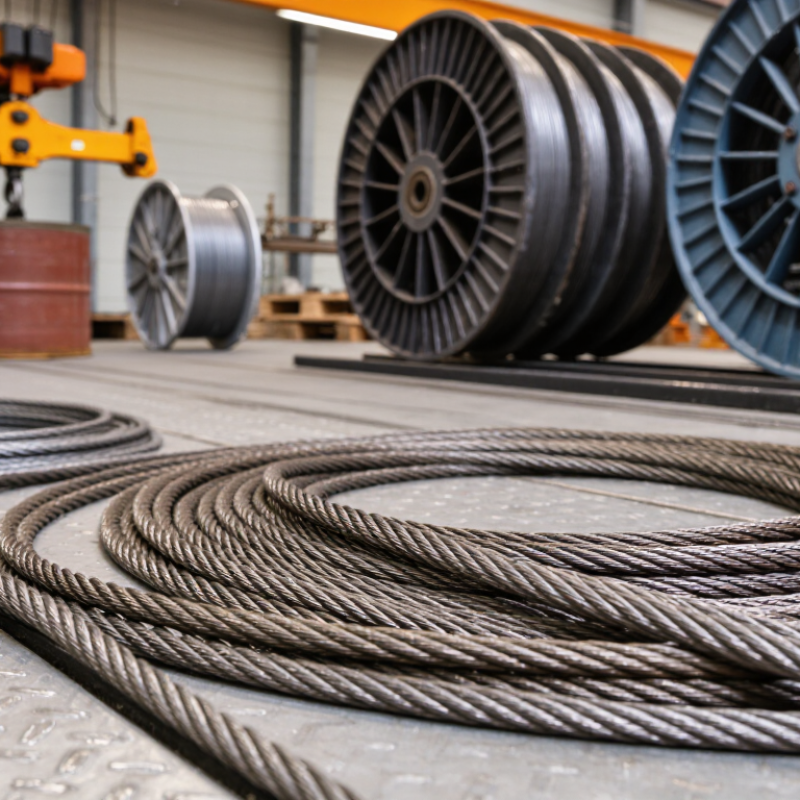
What Type of Wire Rope Is Used for Overhead Cranes?

Common Wire Rope Types Used in Overhead Cranes

Overhead cranes commonly use rotation-resistant wire rope, regular-lay rope, or compacted-strand rope. The right choice depends on the hoist design, lift height, reeving arrangement, and load. There is no universal best. A rope that performs well on one crane may twist or wear quickly on another.

Rotation-resistant ropes use multiple strand layers laid in opposing directions. This construction helps control load spin, especially on tall lifts or single-part reeving. Regular-lay ropes, including common 6×19 and 6×36 constructions, are used where rotation resistance is less critical. Their balance of flexibility and abrasion resistance varies with wire size and construction. Compacted-strand ropes have flattened outer strands, creating a smoother surface that may resist wear in demanding service. Small differences matter.

The core matters too. An independent wire rope core often offers stronger support against crushing on multilayer drums, while a fiber core is more flexible but may suit different duty conditions. Rope selection should match the crane maker’s specifications, sheave grooves, drum layers, and operating load. Check the actual reeving. Rope labels alone can mislead; I would not choose by construction name alone. Regular inspections also reveal damage, kinks, broken wires, or uneven wear that a specification sheet cannot predict.

How Crane Duty and Hoist Design Affect Rope Selection

What Type of Wire Rope Is Used for Overhead Cranes?

How Crane Duty and Hoist Design Affect Rope Selection

The right crane rope depends on duty, not lifting capacity alone. Frequent starts, long shifts, and high lifting speeds increase bending cycles and heat. ISO 4308-1:2003 bases rope selection on the crane mechanism classification and required strength. This helps match rope performance to actual work, rather than choosing by diameter alone. A rope on a lightly used workshop hoist faces different demands from one serving a continuous-production line.

Hoist geometry matters. Measure the sheave-to-rope diameter ratio and check drum grooves, fleet angle, and reeving arrangement. Small sheaves force tighter bends, which can accelerate wire fatigue. For repeated lifting, a flexible multi-strand construction may suit the sheaves; a rotation-resistant design may be needed where the rope runs in multiple layers or carries a freely suspended load. The exact choice still depends on the hoist maker’s specifications.

That detail is easy to miss.

ISO 4309:2017 gives inspection and discard guidance, including checks for broken wires, corrosion, and diameter reduction. Record the rope’s baseline diameter and inspect the same locations over time. A neat-looking rope can still hide internal damage.

Wire Rope Construction: Core, Strands, Lay, and Grade

What Type of Wire Rope Is Used for Overhead Cranes?

Overhead cranes commonly use steel wire rope selected for the hoist’s reeving, drum, sheaves, and duty cycle. Construction matters. A 6×36WS rope has six strands, with 36 wires in each strand, arranged in a Warrington-Seale pattern. The Wire Rope Technical Board’s Wire Rope Users Manual describes how wire count and arrangement affect flexibility and abrasion resistance. More, finer wires can bend readily over sheaves, but may wear faster under severe surface contact. A crane engineer should check the rope maker’s construction data against the actual equipment.

The core supports the strands and helps maintain rope shape. Fiber cores offer flexibility; independent wire rope cores provide greater resistance to crushing and heat. Lay describes the direction and pattern in which wires and strands twist. Ordinary lay is common, while rotation-resistant designs can help control load spin. Grade indicates wire strength, but a higher grade alone does not make a rope suitable. ISO 4309:2017 sets inspection and discard guidance for crane ropes, including criteria for broken wires, diameter reduction, corrosion, and deformation. Real conditions matter.

Tips: Read the crane manual before selecting a replacement. Match construction, diameter, lay, grade, and core. Then inspect the sheaves and drum grooves. A tidy specification sheet can still miss wear on the machine.

Matching Rope Diameter and Strength to Crane Requirements

Choosing wire rope starts with the crane’s rated capacity, but capacity alone is not enough. The rope diameter must match the hoist, drum grooves, and sheaves specified for the crane. A rope that is too large may sit poorly in the grooves; one that is too small can wear quickly and bend excessively. Fit matters.

Check the required minimum breaking force against the rope load, reeving arrangement, and design factor stated in the crane documentation. Breaking force is not the same as usable lifting capacity. The load on each rope part changes with the number of falls, mechanical efficiency, acceleration, and shock loading. Verify these details against the crane’s duty cycle, not just its hook rating. It is easy to overlook repeated fatigue during apparently calm lifts.

Diameter and strength also depend on rope construction, core, and rotation behavior. Confirm the specified construction before making a substitution, especially where the rope runs over small sheaves or may carry an off-center load. Dust and corrosion can speed wear, sometimes between visible strands. Record the installed diameter and compare it with inspection limits. If crane records are incomplete, have a qualified technician verify the selection; a neat calculation can still rest on a wrong assumption.

What Type of Wire Rope Is Used for Overhead Cranes? — Matching Rope Diameter and Strength to Crane Requirements

Overhead-crane hoist ropes are commonly selected from rotation-resistant or regular-lay steel wire rope constructions. The correct construction and diameter depend on the reeving arrangement, rope tension, drum and sheave geometry, duty cycle, and applicable crane requirements.

Rope Type / Construction Typical Crane Application Common Preliminary Diameter Range Strength and Selection Considerations Key Checks Before Selection
6×36 IWRC, ordinary lay General-purpose overhead-crane hoists where rotation resistance is not the primary requirement. Approximately 10–32 mm (3/8–1 1/4 in), depending on crane capacity and reeving. Independent wire-rope core (IWRC) gives a steel core and is commonly used where additional support and strength are required. Minimum breaking force varies with diameter, wire grade, core, and manufacturing specification. Confirm certified minimum breaking force, required design factor, lay direction, and compatibility with the existing drum and sheaves.
6×19 IWRC, ordinary lay Hoists or crane systems where a more abrasion-resistant rope is suitable and the equipment is designed for this construction. Approximately 10–38 mm (3/8–1 1/2 in), depending on the system. Its comparatively larger outer wires can offer abrasion resistance. Flexibility and fatigue performance differ from finer-wire constructions; strength must be taken from the rope’s certified data. Check sheave-to-rope diameter ratio, groove condition, bending fatigue demands, and the rope construction specified by the crane manufacturer.
Rotation-resistant, 19×7 Single-fall or multi-fall hoisting arrangements where load rotation must be controlled and the crane is designed for rotation-resistant rope. Approximately 8–32 mm (5/16–1 1/4 in), subject to equipment design. Opposing strand layers help reduce torque and load rotation. Its performance depends on correct installation, end termination, and operating conditions; it is not interchangeable with ordinary-lay rope. Verify the exact rotation-resistant class required, permitted reeving arrangement, termination instructions, and minimum breaking force.
Rotation-resistant, 35×7 Applications requiring a higher degree of rotation resistance, when specifically allowed by the crane design. Approximately 10–38 mm (3/8–1 1/2 in), subject to equipment design. Multi-strand construction is designed to resist rotation. Construction-specific handling and inspection requirements apply; nominal diameter alone does not establish capacity. Confirm suitability for the crane’s drum, sheaves, reeving, terminations, and required service class with the equipment documentation.
Compacted-strand crane rope High-duty hoisting systems designed to use compacted ropes, often where improved surface contact or fatigue performance is needed. Diameter is specified by the crane design; commonly available in sizes used for industrial hoists. Compaction can increase metallic cross-sectional area for a given nominal diameter, but actual breaking force and fatigue performance remain product-specific. Use certified rope data and verify compatibility with the drum grooves, sheaves, end fittings, and inspection criteria.

Strength-matching method: Determine the maximum tension in one rope part from the lifted load, number of supporting parts, reeving efficiency, and applicable dynamic effects. Compare that tension with the rope’s certified minimum breaking force using the design factor required by the governing standard and crane design. As an illustration only, a 10,000 kg load supported by two ideal rope parts produces about 49 kN of static tension per part before reeving losses or dynamic effects; the required rope strength must then be calculated using the applicable design factor and verified against certified rope data. Diameter ranges above are preliminary guidance, not capacity ratings.

Inspection and Replacement Factors for Crane Wire Ropes

What Type of Wire Rope Is Used for Overhead Cranes?

Inspection and Replacement Factors for Crane Wire Ropes

Overhead cranes commonly use stranded steel wire rope, selected for the drum, reeving system, load, and operating conditions. Rotation-resistant constructions can help control twisting in long lifts, but they are not suitable for every configuration. Follow the crane and rope manufacturers’ specifications. A rope that looks intact may still hide internal wear.

Inspect the rope for broken wires, corrosion, flattening, kinks, birdcaging, and diameter loss. ISO 4309:2017 sets discard criteria according to rope construction, location, and damage; there is no single broken-wire limit for every rope. Its guidance also treats a diameter reduction of 7.5% from nominal as a discard trigger in applicable cases. Record measurements at consistent points, especially near sheaves and drum crossover zones. Replace the rope when it reaches the applicable discard limit, or sooner if damage threatens safe operation. Inspection judgment can be difficult; document the evidence and involve a qualified inspector.

Tips: Check the rope under low tension, then examine the same sections closely. Compare diameter readings with earlier records. OSHA’s 29 CFR 1910.179 calls for frequent inspections, with intervals shaped by service conditions. A monthly check is not a substitute for more frequent attention in severe duty. Be cautious: a clean surface can create false confidence.

Overhead Crane Wire Rope: Broken-Wire Removal Thresholds

OSHA 29 CFR 1910.179 requires a running rope to be removed from service when it has six randomly distributed broken wires in one rope lay, or three broken wires in one strand in one rope lay. These are discard thresholds, not a substitute for inspections for wear, corrosion, deformation, or other damage. Follow applicable standards and the crane or rope manufacturer’s instructions.