
What Is a High Speed Diaper Packing Machine?
A High-speed diaper packing machine is more than a fast conveyor with sealing jaws. It is a coordinated system that counts diapers, forms packages, inserts them into bags, and checks finished packs. Sensors watch film tension. Servo motors adjust timing. A small error can create hundreds of poorly sealed bags within minutes.
Market evidence explains why this equipment matters. Grand View Research estimates that the global baby diapers market reached about USD 83 billion in 2023, with continued growth expected through 2030. Smithers also identifies hygiene products as a major application for nonwoven materials. These reports measure product demand, not machine sales. That distinction matters. Rising diaper consumption does not automatically justify the fastest available line.
Jorge Izquierdo, vice president of market development at PMMI, describes the automation challenge clearly: “Automation should improve consistency, not simply increase speed.” His point is practical. A modern High-speed diaper packing machine must maintain accurate counting, stable bag dimensions, clean seals, and safe operator access. It should also reduce material waste during changeovers.
Speed alone is not enough.
In real production, operators may handle dusty film, compressed diaper stacks, and frequent size changes. A machine that runs at impressive rates but requires long stoppages can underperform. Maintenance access, spare-part availability, and verified output data deserve equal attention. Some manufacturers still compare only packs per minute. That is an incomplete measurement.
This article examines how high-speed diaper packing machines work, which components control performance, and what buyers should evaluate before installation. The technology is powerful. It is not automatically perfect.
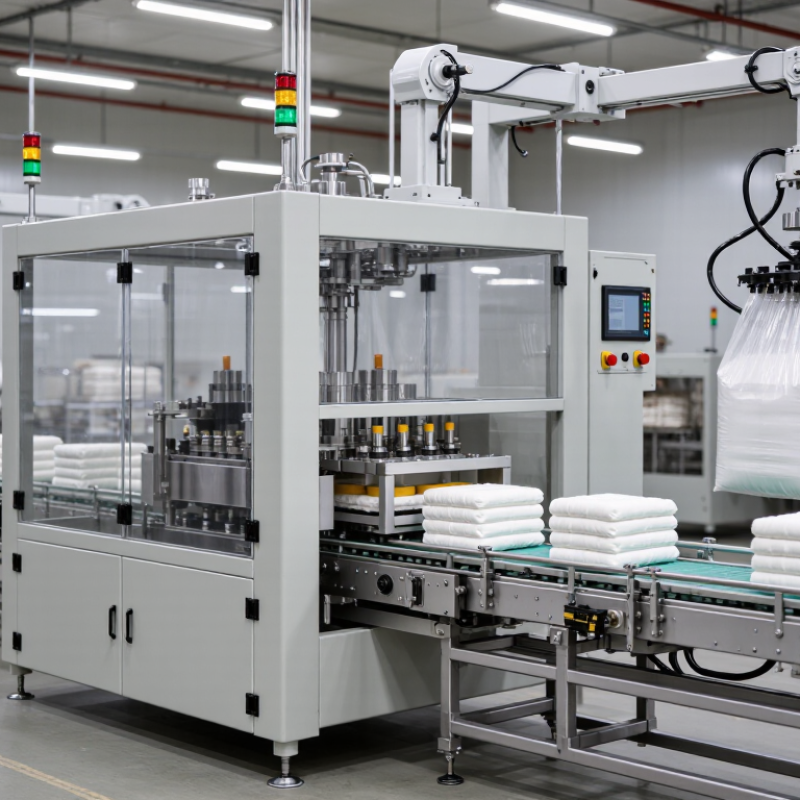
Definition and Scope: Automated Diaper Packing at 20–60 Packs per Minute
What Is a High Speed Diaper Packing Machine?
A high speed diaper packing machine automatically counts, stacks, compresses, and seals diapers. Its working scope usually covers 20–60 packs per minute. At 60 packs per minute, a ten-piece pack can move through sealing every second. That pace demands synchronized feeding, film control, and accurate product detection. Speed matters.
Grand View Research valued the global baby diapers market at about USD 83.3 billion in 2023. Its report projects a 5.7% compound annual growth rate from 2024 to 2030. This demand encourages higher packing capacity, but output alone is not enough. Pack size, diaper thickness, compression level, film width, and changeover time affect real production. A machine rated at 60 packs per minute may deliver less during frequent size changes.
A practical specification should state both nominal speed and verified sustained speed. Operators should inspect stack alignment, seal temperature, film tension, and reject accuracy during trials. Small errors become visible quickly. One misplaced diaper can wrinkle the film or stop the conveyor. The Packaging Machinery Manufacturers Institute’s industry guidance also emphasizes measurable uptime, changeover performance, and operator safety when evaluating automation. These points make the machine’s scope clearer: it is not merely a fast bag sealer, but a coordinated packaging system. A clean spreadsheet can still hide inconsistent feeding. That deserves a second check.
What Is a High Speed Diaper Packing Machine? - Definition and Scope: Automated Diaper Packing at 20–60 Packs per Minute
| Data Dimension | Typical Specification or Range | What It Means | Operational Considerations |
|---|---|---|---|
| Machine Definition | Automatic diaper bagging and packing system | Receives counted diapers, forms a product bundle, inserts it into packaging film or pre-made bags, and seals the finished pack. | The machine is normally installed after diaper production, folding, counting, and product transfer equipment. |
| Nominal Packing Speed | 20–60 packs per minute | The stated range represents the number of completed retail packs produced in one minute under specified operating conditions. | Actual output depends on pack count, diaper size, bag dimensions, film performance, changeovers, and line stoppages. |
| Theoretical Hourly Output | 1,200–3,600 packs per hour | Calculated by multiplying the nominal speed by 60 minutes. | This is a theoretical rate; scheduled production output is usually lower because of material loading, cleaning, adjustments, and planned maintenance. |
| Common Pack Counts | Approximately 20–60 diapers per pack | The counting and grouping system prepares the required quantity before bagging. | Higher diaper counts generally require larger bags and may reduce the achievable packs-per-minute rate. |
| Product Types | Baby diapers, training pants, and selected adult incontinence products | The same packing concept can serve several absorbent-hygiene products when the feeding and forming systems are compatible. | Product width, thickness, folding pattern, and compressibility must be matched to the machine configuration. |
| Packaging Materials | Polyethylene-based plastic film, laminated film, or pre-made plastic bags | The packaging material forms the outer protective pack and carries printed product information when required. | Film thickness, coefficient of friction, sealability, and roll quality affect feeding and sealing stability. |
| Primary Packing Method | Film forming, product insertion, heat sealing, and bag discharge | The system converts packaging film into a bag or sleeve, inserts the diaper bundle, and closes the pack. | Seal temperature, pressure, dwell time, and alignment must be controlled to prevent open or wrinkled seals. |
| Counting Accuracy | Controlled by electronic counting and product-detection sensors | Sensors and programmed counters help verify that each pack receives the intended number of products. | Sensor calibration, stable product spacing, and regular inspection are necessary for reliable count control. |
| Automation Functions | Automatic feeding, counting, bag forming, sealing, cutting, discharge, and fault detection | Integrated controls reduce manual handling between diaper production and finished-pack discharge. | The degree of automation varies according to line layout, packing format, and required inspection functions. |
| Pack Formats | Flat packs, pillow-style bags, and selected compressed packs | The selected format determines the bag shape, sealing arrangement, and downstream handling requirements. | Compressed formats may require additional air removal or compression equipment before final sealing. |
| Changeover Capability | Adjustable for different diaper sizes and pack counts | Operators can change production settings for different product specifications and retail pack configurations. | Changeover time depends on tooling, bag dimensions, recipe settings, cleaning requirements, and operator experience. |
| Quality Inspection | Pack presence, seal integrity, product count, film position, and basic dimension checks | Inspection functions help identify incomplete packs, sealing faults, misalignment, and missing products. | Additional checkweighing, vision inspection, or metal detection may be installed when required by the production specification. |
| Utilities | Electrical power and, for many systems, compressed air | Electric motors and controls drive the machine, while pneumatic components may operate cylinders and actuators. | Required voltage, power load, air pressure, and air quality must be confirmed before installation. |
| Production Scope | Medium- to high-volume automated diaper packing | The 20–60 packs-per-minute range is intended for continuous production environments rather than occasional manual packing. | Line balancing is important so that diaper production, packing, conveying, and palletizing capacities are compatible. |
| Key Performance Factors | Speed, count accuracy, seal quality, material utilization, uptime, and changeover time | These indicators provide a more complete evaluation than nominal speed alone. | Actual performance should be verified using the intended diaper sizes, pack counts, film, and production schedule. |