Who Are the Top 7th Axis Robot Manufacturers in China?
A 7Th Axis Robot adds a powered travel track to a conventional industrial robot, extending its working range along a production line. In a Chinese factory, that track might carry a welding arm between several fixtures or help a palletizing robot serve multiple stations. The idea is straightforward. Choosing a suitable system is not.
Track length, payload, travel speed, positioning accuracy, and controller compatibility all affect performance. So do practical details: floor space, cable routing, safety guarding, and access for maintenance. A system that looks impressive in a catalog may not fit a crowded workshop. Small details matter. They often decide whether an installation runs smoothly or needs costly changes.
This guide introduces seven manufacturers associated with China’s 7th-axis robot market and explains what buyers should examine when comparing them. Product range alone is not enough. Reliable evaluation also considers documented technical specifications, relevant application experience, integration capabilities, service coverage, and customer references where available. These details can be difficult to compare consistently, and public information may not answer every question. That is worth acknowledging.
The companies presented here should be treated as a starting point for research, not a universal ranking. A good match depends on the robot model, workpiece, cycle time, site conditions, and required travel distance. Ask suppliers for configuration drawings and clear performance data. Then verify that the proposed track suits the actual process. The right choice is usually the one that fits the job—not the one with the boldest claim.
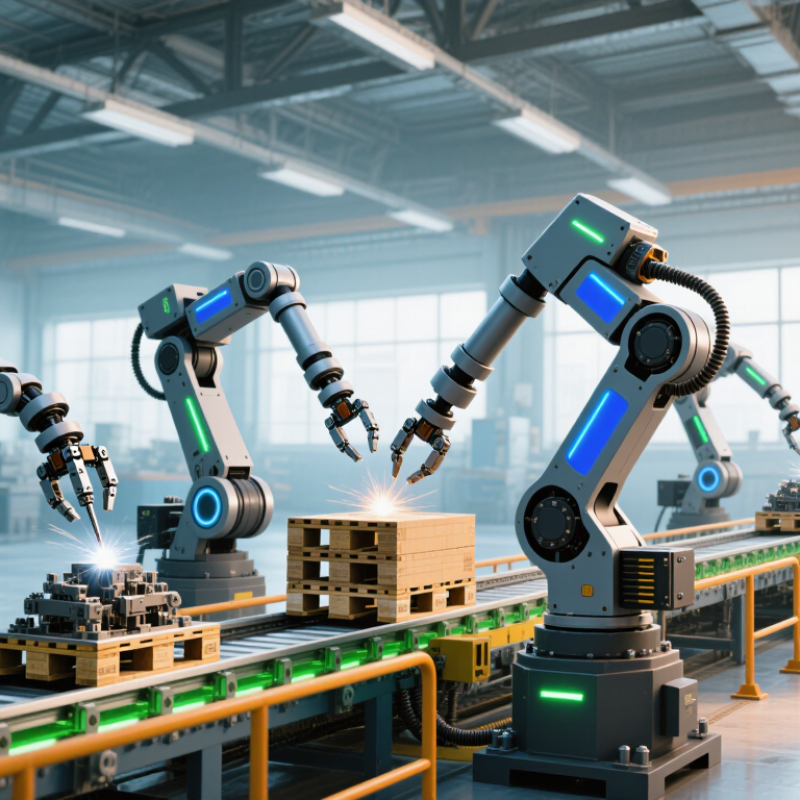
What Is a 7th Axis in Robotic Automation?
In robotic automation, a seventh axis usually means a powered linear track that moves the robot along the floor or a raised structure. The robot’s six joints still handle rotation and positioning; the track adds travel across a longer work area. Picture a robot welding one side of a large frame, then gliding several metres to reach the other side. The rail does not add another arm joint. It changes where the whole arm can work.
This added travel can reduce the need for multiple robots or repeated part repositioning. It is useful for machine tending, welding, and handling long components. But the track must match the task. Engineers consider payload, travel length, speed, stopping accuracy, floor strength, and cable routing. Small details matter: a poorly placed cable carrier can interfere with motion, while an uneven foundation may affect positioning. It is not magic.
A sound layout also accounts for the robot’s reach at each point on the rail, not just the track’s total length. Control coordination and safety measures need careful planning. In practice, the longest rail is not always the best choice; extra travel can add cost and complexity without improving cycle time. Manufacturers can be compared by their rail construction, motion performance, integration support, and documented test data. Real installations still need validation against the actual workpiece and operating conditions.
How to Evaluate 7th-Axis Robot Manufacturers in China
When evaluating 7th-axis robot manufacturers in China, begin with the workpiece, not the brochure. Record the robot’s payload, tool weight, travel distance, speed, and required positioning accuracy. A long track may flex under acceleration, especially when the robot reaches its far end. Ask for load and deflection data at that position, not only at the center. Check floor-mounting requirements, rail protection, cable routing, and compatibility with your robot controller. Small details matter. Confirm how the supplier handles dust, lubricant, and routine inspection.
Review engineering capability and delivery support together. Request layout drawings, electrical schematics, installation guidance, and a clear commissioning plan. Ask who will troubleshoot faults remotely and how spare parts are identified. A useful reference should match your application, such as similar payloads, cycle speeds, or factory conditions. Run the real cycle. Test with the actual tool and representative workpieces, then record repeatability, stopping behavior, and recovery time after a fault. I would not treat a polished demonstration as proof of production readiness; even a careful test can miss a shift-specific problem. Agree on measurable acceptance criteria before ordering, and keep the results in writing.
Leading 7th-Axis Robot Manufacturers in China
Leading 7th-Axis Robot Manufacturers in China
China’s leading 7th-axis robot manufacturers are best assessed by engineering fit, not catalogue size. A seventh axis extends a robot’s reach along a linear rail, helping it serve multiple workstations or handle long components. Strong suppliers can explain how payload, travel length, speed, and repeatability interact in a specific cell. Ask for measured performance under your robot’s actual load, not only unloaded specifications. Details matter.
Review the rail structure, drive system, cable routing, and controller integration. For example, a 10-meter travel path beside a welding fixture needs stable motion, protected cables, and reliable position feedback. Request drawings, installation tolerances, maintenance intervals, and references for similar applications. A capable manufacturer should also discuss floor preparation and commissioning support. Yet published specifications are not always directly comparable; some details may be missing, so verify them in writing. An onsite acceptance test can reveal issues that a brochure cannot.
Tips: Share robot model, payload, tool weight, travel distance, and cycle time before requesting a quotation. Test it onsite. Check repeatability at several positions, including near both ends of the rail.
How to Choose a 7th-Axis Robot Manufacturer for Your Needs
Choosing a 7th-axis robot manufacturer starts with the workpiece, not the catalog. Check payload at full reach, rail stroke, travel speed, and repeatability under your actual load. A long rail can add useful reach, but it may also bring vibration, floor-loading, and cable-management challenges. Ask for test results and drawings that match your layout.
The International Federation of Robotics reported 541,302 industrial robot installations worldwide in 2023, with operational stock reaching 4,281,585 units. These figures show the scale of automation, but they do not prove a track will suit your process. Request a clear duty-cycle estimate, integration plan, safety documentation, and references for similar applications. Where relevant, ask how positioning performance was measured and under what conditions. A polished brochure is not enough; I would want to see the test setup, too.
Tips: Bring a simple floor plan with robot reach, payload, cycle time, and workpiece dimensions. Ask who handles installation, commissioning, and spare parts. Compare the total system cost, not just the rail price. Small details matter. I would also leave room for uncertainty: real production conditions rarely match a perfect demo.
Who Are the Top 7th Axis Robot Manufacturers in China? - How to Choose a 7th-Axis Robot Manufacturer for Your Needs | # | Evaluation Factor | What to Compare | Questions to Ask Each Manufacturer |
| 1 | Travel and usable stroke | Specified travel length, usable robot working area, end stops, and any stroke lost to mounting or cable routing. Compare in millimetres or metres. | What is the usable stroke for the proposed layout, and can the supplier provide a layout drawing showing the robot’s reachable area? |
| 2 | Load capacity and mounting | Allowable moving mass, including the robot, fixtures, cables, and other equipment carried by the carriage. Check floor, wall, or ceiling mounting requirements. | What maximum moving mass and load moment are permitted, and what foundation or anchoring details are required? |
| 3 | Speed and acceleration | Rated travel speed and acceleration, considered alongside the robot’s payload, travel distance, stopping distance, and production cycle. | Are the quoted speed and acceleration available with the proposed load, and what cycle-time assumptions were used? |
| 4 | Positioning performance | Positioning accuracy and repeatability, stated in millimetres and under defined operating conditions. Do not treat accuracy and repeatability as interchangeable measures. | Can the supplier provide test conditions and performance data for the proposed configuration, including load and travel position? |
| 5 | Robot and controller compatibility | Supported robot models, controller interfaces, motion synchronization, programming method, and integration requirements. | Is the exact robot-and-controller combination supported? Who is responsible for commissioning the coordinated motion? |
| 6 | Safety and documentation | Risk assessment, guarding provisions, emergency-stop integration, safety-device interfaces, operating instructions, and applicable machinery-safety documentation. | Which safety functions are included, which are supplied by the integrator, and what documentation will be delivered for the completed cell? |
| 7 | Installation and lifecycle support | Installation and commissioning scope, warranty terms, spare-parts availability, maintenance instructions, and technical-support arrangements. | What are the written warranty and service terms, recommended maintenance intervals, and lead times for critical replacement parts? |
This is a supplier-selection framework, not a ranking or a set of manufacturer-specific specifications. Request written, configuration-specific data and verify performance against the application requirements before purchase.