
Top 10 Joint Flange Manufacturers for Global Buyers
Choosing a Joint Flange manufacturer is not just a price comparison. A flange may look correct on a drawing, yet still cause problems if its dimensions, material, or pressure rating do not match the application. For global buyers, checking technical documents matters as much as reviewing a catalogue. Details matter.
This guide introduces ten manufacturers for buyers comparing suppliers across regions. It considers factors such as product range, manufacturing capabilities, quality controls, material traceability, and export support. These are practical starting points, not guarantees of performance. Buyers should confirm current specifications, applicable standards, inspection records, and delivery terms directly with each supplier. A mill certificate, a clear dimensional drawing, and a realistic lead-time estimate can reveal more than a polished product page.
The right choice depends on the project. A maintenance team replacing a flange on existing piping may prioritize exact dimensions and quick availability. An engineering contractor working on a new system may need customized designs, documented testing, and consistent production volumes. No single manufacturer will suit every requirement. That is worth remembering.
The ranking should therefore be treated as a comparison, not an endorsement. Company capabilities and product offerings can change, and published information may not capture every limitation. Request written confirmation before placing an order, and have qualified personnel review technical fit. A small detail can matter.
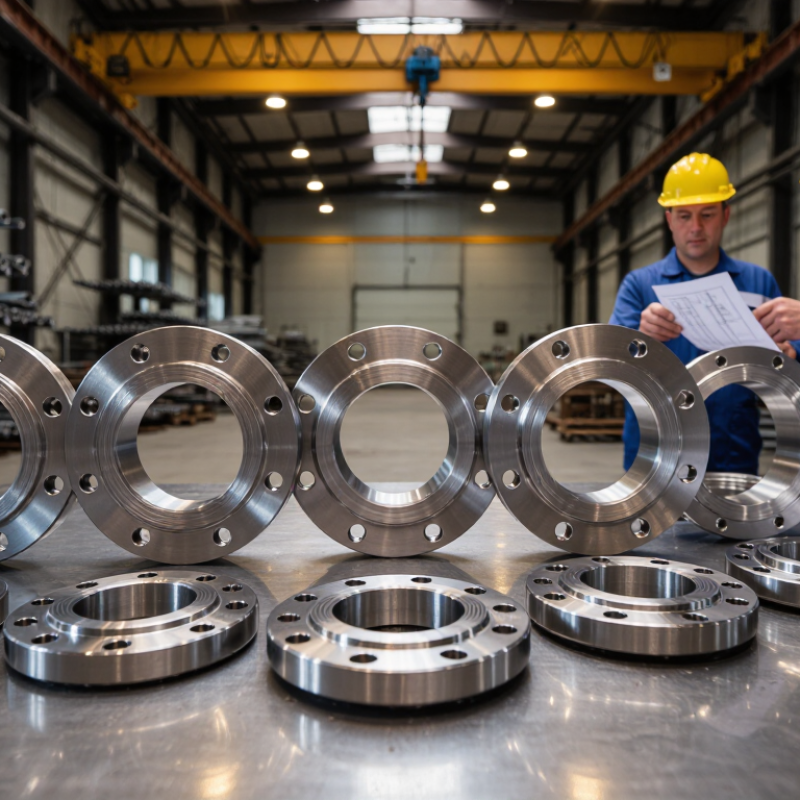
Joint Flanges: Types, Materials, and Industrial Applications
Joint flanges connect pipes, valves, pumps, and vessels, but their type affects installation and service. Weld-neck flanges suit demanding pressure and temperature conditions because their tapered hubs distribute stress. Slip-on flanges are easier to align in many general-service lines. Blind flanges close pipe ends; threaded types can avoid welding where service conditions permit. Selection still depends on pressure rating, temperature, vibration, and applicable piping codes.
Common materials include carbon steel for many utility and process lines, stainless steel for improved corrosion resistance, and alloy steel for elevated-temperature duties. Material choice must match the fluid, operating conditions, gasket, and bolting. The World Steel Association’s World Steel in Figures 2024 reports 1,892.2 million tonnes of crude steel production in 2023. That shows steel’s industrial scale, not the quality of any individual flange. A polished face can still fail if its gasket finish or dimensions are wrong.
Tips: Check flange facing, bore, pressure class, and bolt-hole alignment against the piping specification before installation. In the field, a few millimeters of mismatch can delay assembly. It sounds minor. It isn’t. Recheck material certificates and inspect sealing surfaces for dents or corrosion before tightening.
Top 10 Joint Flange Manufacturers for Global Buyers - Joint Flanges: Types, Materials, and Industrial Applications
Global buyer reference: ten common flange types and specification considerations. This is a product-selection guide, not a ranked list of companies or manufacturers.
| No. | Flange Type | Design Features | Common Materials | Relevant Standards | Typical Industrial Applications |
|---|---|---|---|---|---|
| 1 | Weld Neck Flange | Has a tapered hub and is butt-welded to the pipe; commonly selected for demanding pressure, temperature, or cyclic service. | Carbon steel, stainless steel, alloy steel, duplex stainless steel | ASME B16.5; ASME B16.47 for specified large-diameter sizes; EN 1092-1 | Oil and gas, petrochemical processing, power generation, and high-pressure piping |
| 2 | Slip-On Flange | Fits over the pipe and is typically fillet-welded on the hub and bore sides; installation is straightforward. | Carbon steel, stainless steel, alloy steel | ASME B16.5; EN 1092-1 | Water treatment, general process piping, utilities, and lower-stress industrial services |
| 3 | Blind Flange | Solid flange with no bore, used to close a pipe end, valve opening, or pressure-vessel nozzle. | Carbon steel, stainless steel, alloy steel | ASME B16.5; ASME B16.47 for specified large-diameter sizes; EN 1092-1 | Pipeline isolation, pressure testing, maintenance access, and future system expansion |
| 4 | Socket Weld Flange | Pipe inserts into a recessed socket and is secured with a fillet weld; generally used for small-bore piping. | Carbon steel, stainless steel, alloy steel | ASME B16.5 | Small-diameter high-pressure lines, hydraulic systems, and process instrument connections |
| 5 | Threaded Flange | Connects to a pipe with matching threads, avoiding a field weld; thread form and compatibility must be specified. | Carbon steel, stainless steel, malleable or ductile iron where permitted by the design | ASME B16.5; thread specifications depend on the selected connection | Low-pressure utilities, fire-protection systems, and locations where welding is impractical |
| 6 | Lap Joint Flange | Used with a separate stub end; the flange can rotate for bolt-hole alignment and is not welded directly to the pipe. | Carbon steel or other suitable backing-flange material; corrosion-resistant stub-end material selected for the service | ASME B16.5; EN 1092-1 | Corrosive process lines, frequent dismantling, and systems where alignment flexibility is useful |
| 7 | Orifice Flange | Designed to hold an orifice plate and provide pressure-tap connections for differential-pressure flow measurement. | Carbon steel, stainless steel, alloy steel | ASME B16.36 | Flow measurement in oil and gas, chemical processing, refining, and power-plant piping |
| 8 | Plate Flange | Flat plate-style flange with a central bore; dimensions, facing, and welding details depend on the applicable specification. | Carbon steel, stainless steel | EN 1092-1, Type 01; other designs may be governed by project specifications | Water distribution, tanks, ducts, and general low- to medium-pressure services |
| 9 | Ring-Type Joint (RTJ) Facing Flange | Uses machined grooves and a metal ring gasket to form a pressure-resistant seal; the facing and gasket must be compatible. | Carbon steel, stainless steel, alloy steel | ASME B16.5 or ASME B16.47, as applicable; ring-joint gasket details are covered by ASME B16.20 | High-pressure and high-temperature oil, gas, refining, and petrochemical service |
| 10 | Large-Diameter Flange | Flanges for larger pipe sizes require careful checks of dimensions, pressure class, facing, bolt pattern, and governing specification. | Carbon steel, stainless steel, alloy steel | ASME B16.47 for its covered size range; EN 1092-1 where specified | Large pipelines, water infrastructure, power plants, and industrial process headers |
Procurement note: Material grades, pressure class, size range, facing, gasket, bolting, dimensions, and inspection requirements should be confirmed against the applicable project code and service conditions. Common material specifications include ASTM A105 for carbon-steel forgings and ASTM A182 grades for alloy and stainless-steel forgings; suitability depends on the design and operating environment.