Understanding Switching Power Supply Types and Their Applications?
In the realm of modern electronics, the "Switching Power Supply" plays a pivotal role. Its importance cannot be overstated. Dr. Emily Hartman, a leading expert in power electronics, once stated, “Switching Power Supplies are the backbone of efficient energy conversion." This underscores their critical function in countless devices we use daily.
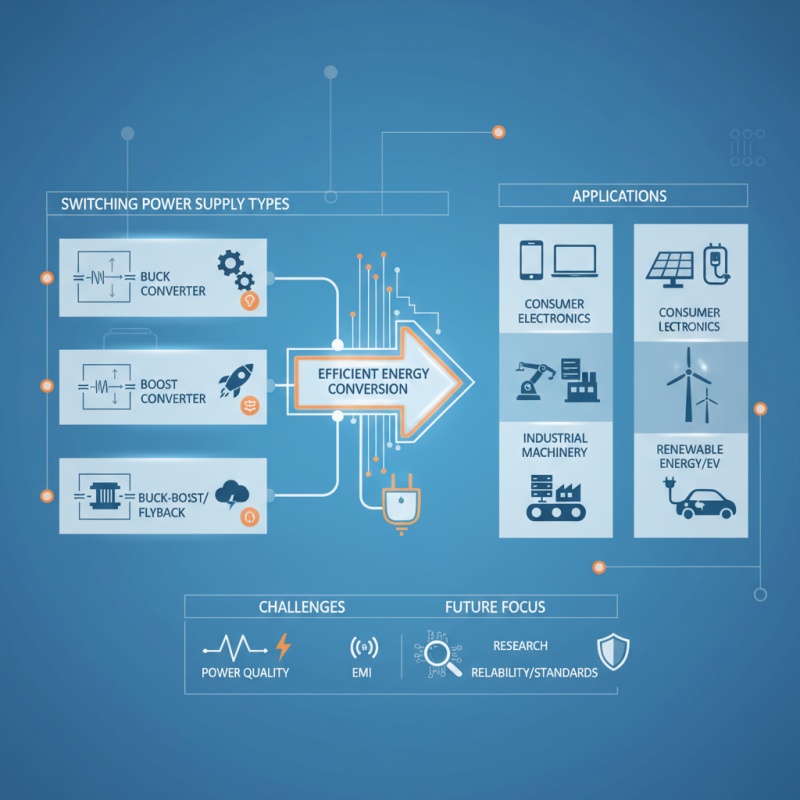
Switching Power Supplies are versatile and efficient. They convert electrical energy with minimal loss. This capability makes them suitable for various applications, from consumer electronics to industrial machinery. The compact design allows manufacturers to save space and weight in products. However, not all Switching Power Supplies are created equal. Their complexity can be daunting for designers and engineers.
Despite their advantages, challenges exist. Power quality issues and electromagnetic interference can arise. These aspects require careful attention and design consideration. As the industry evolves, ongoing research into improving Switching Power Supplies will be essential. Questions about standards and reliability must also be addressed. Understanding these factors is vital for anyone involved in electronic design.
Types of Switching Power Supplies: An Overview
Switching power supplies (SPS) are essential in many modern electronic devices. They convert electrical energy efficiently, making them popular in consumer electronics, automotive, and industrial applications. Industry reports show that the global switching power supply market is projected to grow significantly, reaching over $35 billion by 2026. This growth reflects the increasing demand for energy efficiency and compact designs.
Different types of switching power supplies serve various functions. Buck converters reduce voltage while boosting current, ideal for battery-powered devices. Boost converters increase voltage, often used in electric vehicles. Moreover, buck-boost converters can perform both functions, adapting to versatile power needs. However, each type has its drawbacks. Efficiency can drop under certain loads. Additionally, the complexity of the design can lead to increased costs.
Using these power supplies also presents challenges. Filtering techniques must be carefully considered to reduce noise. High-frequency switching can lead to electromagnetic interference (EMI), complicating compliance with regulatory standards. Engineers often find themselves balancing efficiency and performance against cost and complexity. As technology evolves, further innovations are necessary to overcome these hurdles.
Key Components of Switching Power Supplies
Switching power supplies have a variety of applications across many industries. They are essential for voltage regulation in electronic circuits. The key components of these power supplies play crucial roles in their functionality.
One of the primary components is the transformer. It steps up or steps down voltage. This process is vital for efficiency. The inductor is another critical part. It stores energy temporarily and smooths out the output voltage. Capacitors also help maintain stable voltage levels, filtering out noise.
Despite their benefits, challenges arise. Components can overheat with heavy loads. This can lead to reduced efficiency, affecting performance. Users must pay close attention to cooling solutions. Inadequate thermal management may result in component failure. It’s a balancing act that requires careful consideration and sometimes, trial and error.
Advantages of Switching Power Supplies Compared to Linear Regulators
Switching power supplies have gained significant traction in various industries due to their efficiency and versatility. Unlike linear regulators, which waste energy as heat, switching power supplies utilize a high-frequency switching method. This results in a more efficient energy conversion. According to a report by ResearchGate, switching regulators can achieve efficiencies up to 95%, while linear regulators often max out around 50-60%. This efficiency leads to lower operating costs and less heat generation, which is crucial for compact electronic devices.
Moreover, the compactness of switching power supplies allows for their integration into smaller spaces. This is important in the context of modern electronic design, where space is a premium. A study by the International Journal of Electrical Engineering & Technology highlights that power density in switching supplies can reach 100 W/in³ or more. However, this compact design does invite challenges. It often complicates thermal management, requiring careful planning in heat dissipation mechanisms.
While the advantages are clear, the complexity of design is something to consider. Switching supplies may introduce electromagnetic interference (EMI), which can affect the performance of nearby electronic components. According to data from the National Institute of Standards and Technology, it is essential to incorporate EMI suppression techniques to mitigate these issues. Balancing efficiency with performance remains a key challenge in the implementation of switching power supplies.
Understanding Switching Power Supply Types and Their Applications - Advantages of Switching Power Supplies Compared to Linear Regulators
| Power Supply Type | Advantages | Typical Applications | Efficiency | Size |
| Linear Regulator | Simple design, low noise | Low-power devices, audio equipment | 70-80% | Large |
| Switching Power Supply | High efficiency, compact size, less heat | Computers, telecommunications, industrial applications | 85-95% | Small |
| Buck Converter | Reduces voltage efficiently, low cost | Battery-operated devices, portable electronics | 90-95% | Very small |
| Boost Converter | Increases voltage, configurable | Solar power systems, electric vehicles | 85-90% | Compact |
| Flyback Converter | Isolated outputs, versatile | Telecom, power adapters | 75-85% | Medium |
Typical Applications of Switching Power Supplies in Various Industries
Switching power supplies (SPS) have become essential in various industries due to their efficiency and versatility. In the telecommunications sector, for example, SPS units are crucial for powering network equipment. Reports indicate that the global telecommunications power supply market is expected to reach $9 billion by 2027. This growth highlights the increasing demand for reliable power solutions.
In the automotive industry, SPS are used in electric vehicles (EVs) to manage battery systems and onboard electronics. Data suggests that the EV market could exceed 30 million units annually by 2025, driving further innovation in power supply technologies. Additionally, the healthcare sector relies on SPS for medical devices and imaging equipment. Accurate and stable power is critical, as even minor fluctuations can affect device performance.
Tips: Ensure proper ventilation. Heat can impact efficiency. Regularly assess system performance, as inefficiencies can occur over time. Despite advancements, some SPS designs may still struggle with electromagnetic interference. Continuous improvement is vital for reliable operation.
Challenges and Considerations in Designing Switching Power Supplies
Designing switching power supplies presents several challenges that engineers must navigate. These supplies are crucial for various applications, yet their complexity can lead to issues. High-frequency operation can cause electromagnetic interference (EMI), which can disrupt neighboring circuits. This problem requires careful layout design and filtering techniques to minimize noise.
Thermal management is another significant consideration. Switching power supplies can generate substantial heat. If not properly managed, this heat can lead to failure. Engineers often face the dilemma of finding the right balance between efficiency and heat dissipation. Choosing adequate components that can withstand high temperatures is essential.
Additionally, transient response is critical in power supply design. A fast transient response ensures that output voltage remains stable during load changes. However, achieving this stability can be tricky. Engineers may have to iterate several times to ensure that all conditions are met. Testing and refining designs is a reality in this field. Addressing these challenges requires creativity and ongoing learning.