
What Are Floor Insulation Boards and How Do They Work?
Floor Insulation Boards are rigid panels designed to slow heat movement through floors. They may sit beneath a concrete slab, above a ground-bearing floor, or between timber joists. Common materials include expanded polystyrene, extruded polystyrene, PIR, phenolic foam, and wood fibre. Each material behaves differently.
The principle is straightforward. The board traps tiny pockets of air or uses a low-conductivity structure to resist heat flow. A warmer room then loses less heat through the floor. The surface can feel less cold underfoot, especially near external walls and unheated garages. However, insulation does not work alone. Joints, edges, moisture, compression, and thermal bridges can weaken the result. Small gaps matter.
Building scientist Joseph Lstiburek offers a useful reminder: “A building is a system.” Floor Insulation Boards must therefore match the floor design, moisture conditions, loading requirements, and local building guidance. A high-performance board may still fail when it is installed over a damp base or crushed beneath excessive weight. That detail is easy to underestimate.
This guide examines how these boards function, where they are installed, and what their limitations mean in practice. It will consider thermal resistance, compressive strength, vapour movement, and edge detailing. It will also question a common assumption: thicker insulation is not automatically better. Sometimes, careful installation delivers more value than simply adding another layer. Real floors are rarely perfect. Good design accepts that, then reduces the weaknesses.
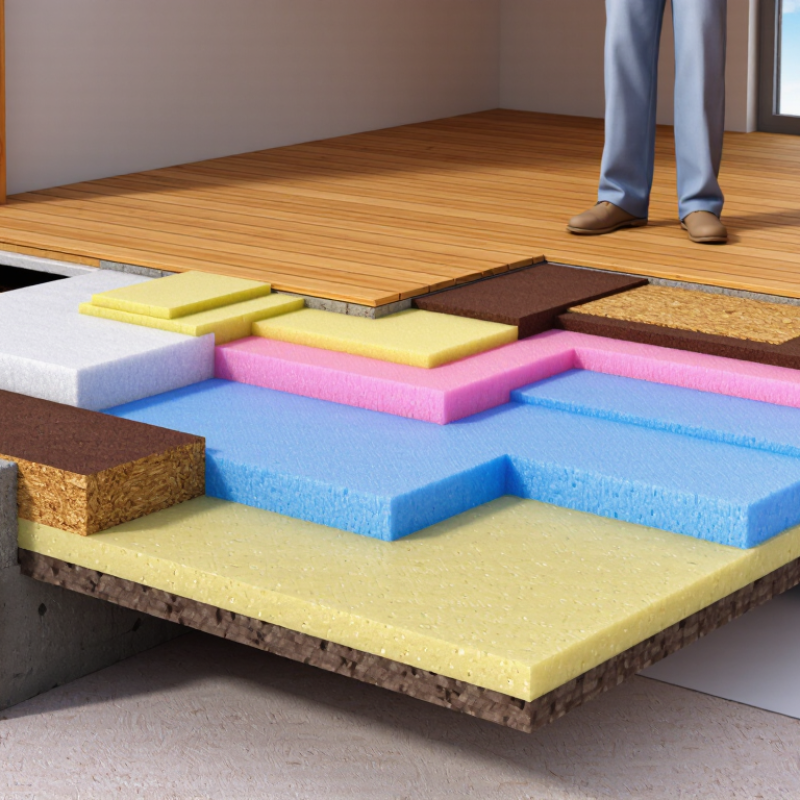
Floor Insulation Boards Defined: Materials and λ-Values of 0.020–0.040 W/m·K
Floor insulation boards are rigid panels installed beneath, between, or above floor structures. They reduce heat loss by slowing conduction through the floor. Common materials include expanded polystyrene, extruded polystyrene, polyisocyanurate, phenolic foam, and mineral wool boards.
Their thermal performance is often shown by the lambda value, written as λ. This measures how easily heat passes through one metre of material. Lower numbers generally mean better insulation. Boards with λ-values from 0.020 to 0.040 W/m·K can provide strong resistance in relatively thin layers. For example, a 100-millimetre board with a λ-value of 0.025 W/m·K has an approximate thermal resistance of 4.0 m²·K/W.
Small details matter. Gaps around board edges can create cold bridges, even when the product has a low λ-value. A slightly compressed joint may also reduce the expected performance. In real installations, I would check moisture exposure, compressive strength, floor loading, and compatibility with adhesives or membranes. This is where specifications become practical.
Not every low λ-value guarantees a warmer floor. Performance depends on thickness, workmanship, moisture, and surrounding construction. Laboratory figures can seem precise, but building sites are less forgiving. Mineral wool may offer useful fire resistance and sound absorption, while foam boards often provide higher thermal efficiency per millimetre. The correct material depends on the floor design, local climate, and professional assessment.、】【
| Insulation Board Material | Typical λ-Value (W/m·K) | Typical Density (kg/m³) | Typical Compressive Strength (kPa) | How It Works in a Floor | Common Floor Applications | Key Considerations |
|---|---|---|---|---|---|---|
| Polyisocyanurate (PIR) | 0.020–0.026 | 30–40 | 120–200 | Traps low-conductivity gas in a rigid cellular structure, reducing heat flow through the floor. | Ground floors, floors above unheated spaces, suspended floors, and retrofit systems where space is limited. | High thermal performance at relatively low thickness; joints should be tightly fitted and protected from moisture and damage. |
| Phenolic Foam | 0.020–0.025 | 35–45 | 100–150 | Uses a fine closed-cell structure to slow conduction and limit air movement within the board. | Thin floor build-ups, ground floors, and floors requiring a high level of thermal resistance. | Very low λ-values; board edges and surface facings must be considered when detailing joints and moisture control. |
| Extruded Polystyrene (XPS) | 0.029–0.036 | 28–45 | 200–700 | Closed-cell foam resists heat transfer and absorbs relatively little water compared with open-cell materials. | Concrete ground floors, floors exposed to intermittent moisture, perimeter zones, and inverted or heavily loaded floor assemblies. | Good moisture resistance and high compressive strength; performance depends on long-term loading and board thickness. |
| Expanded Polystyrene (EPS) | 0.031–0.038 | 15–35 | 70–200 | Small air-filled beads reduce conduction while the rigid board limits convection within the insulation layer. | Ground-bearing floors, floors above garages or unheated rooms, and general-purpose floor insulation. | Lightweight and economical; select an appropriate grade for the expected permanent and temporary loads. |
| Mineral Wool Floor Board | 0.035–0.040 | 100–180 | 30–80 | Interlocking mineral fibres trap air and reduce conduction, while also helping absorb airborne and impact sound. | Timber floors, floors above unheated spaces, acoustic floor systems, and cavity-filled suspended floors. | Strong acoustic and fire-resistance characteristics; requires protection from persistent moisture and careful support detailing. |
| Rigid Wood-Fibre Board | 0.038–0.040 | 110–250 | 100–200 | Compressed wood fibres create a porous structure that slows heat transfer and contributes to moisture buffering. | Suspended timber floors, floors in breathable construction, and renovation projects using natural-fibre materials. | Heavier than polymeric foams; moisture exposure, edge support, and structural loading must be assessed in the design. |
| Foil-Faced Rigid Foam Board | 0.020–0.035 | 30–45 | 100–250 | The foam core provides the main insulation, while the facing can reduce radiant heat transfer and act as a vapour-control layer when correctly sealed. | Solid floors, suspended floors, and floors where a continuous vapour-control layer is required. | Reflective foil does not replace the foam’s thermal resistance; any vapour-control function depends on sealed laps, joints, and penetrations. |
| How to read the λ-value: Lambda (λ) measures thermal conductivity. A lower value indicates better insulation performance for the same thickness. The approximate thermal resistance of a 100 mm layer is calculated as thickness ÷ λ; for example, λ = 0.025 W/m·K gives approximately R = 4.0 m²·K/W. Actual design values should use the declared product data, installation conditions, moisture exposure, joints, thermal bridges, and applicable building regulations. | ||||||