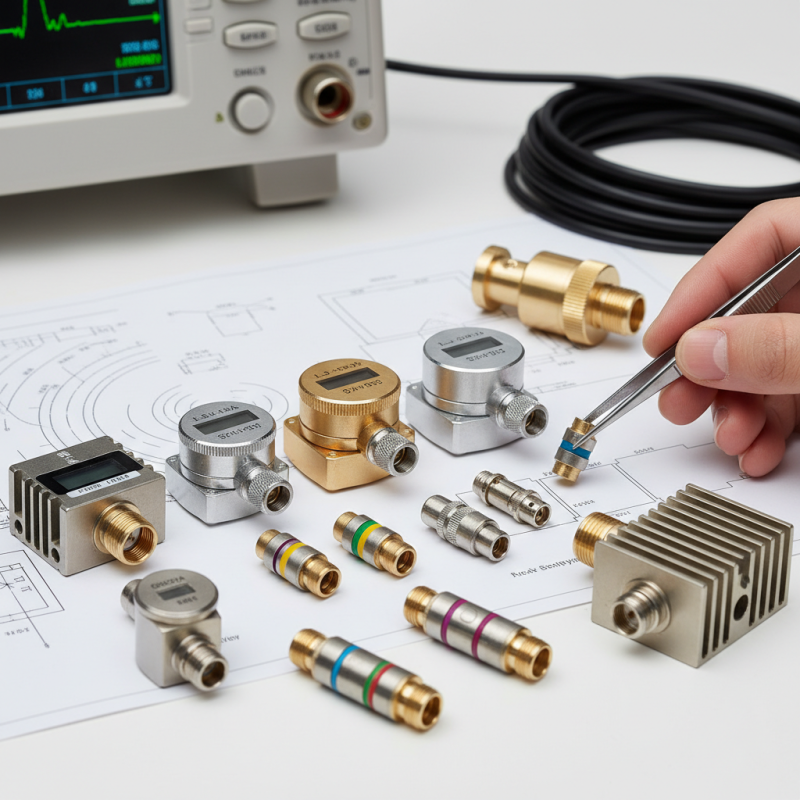
How to Choose the Right Coaxial Attenuator for Your Needs?
Choosing the right Coaxial Attenuator is crucial for optimizing signal quality in various applications. A coaxial attenuator controls the power flow of signals in coaxial cables. Its role can significantly impact performance. Thus, it's important to understand what you need.
Different specifications exist when selecting a coaxial attenuator. It's essential to consider factors like frequency range, power handling capacity, and connector type. For instance, using the wrong attenuator can lead to signal distortion. Many users overlook these details, leading to frustrating results.
Selecting the appropriate coaxial attenuator may seem straightforward. However, it's often more complex. Knowledge of specific requirements is vital to avoid mistakes. Take time to evaluate your needs carefully. A well-chosen attenuator can enhance system performance significantly.
Understanding Coaxial Attenuators: Definitions and Functions
Coaxial attenuators are essential components in electronic systems. They reduce signal strength to prevent overloading. This protection is crucial in many applications. An attenuator helps maintain optimal performance by ensuring signals are not excessively strong.
Understanding their definitions is vital. An attenuator is a passive device that decreases signal amplitude. It does this without distorting the signal, which is key. Coaxial attenuators specifically use coaxial cables. These cables are common in television and radio transmission. The way they function is straightforward. They absorb some of the signal energy, lowering its power.
However, choosing the right attenuator can be tricky. Many factors need consideration, such as frequency range and power handling. You might overlook impedance matching, which is important for system reliability. Some may think one size fits all, but that’s not the case. Each application might have a unique requirement, leading to potential mismatches. Reflecting on these details can be helpful.
Key Factors to Consider When Choosing a Coaxial Attenuator
Choosing the right coaxial attenuator involves considering several key factors. The frequency range is crucial. Attenuators are not one-size-fits-all. Different devices operate at different frequencies. Ensure the attenuator matches your system's needs, or you may face signal issues.
Power rating is another essential detail. It measures how much power the attenuator can handle. Using an attenuator with a lower rating can lead to damage. Assess the power requirements of your devices carefully. Not doing so might result in frustrating failures or degraded performance over time.
Impedance is significant too. Common values are 50 ohms and 75 ohms. Mismatched impedance can cause reflections and signal loss. Always verify the impedance of your components. If they do not match, your system may not perform optimally. Users often overlook this aspect, which can lead to costly mistakes.
Types of Coaxial Attenuators and Their Specific Applications
Coaxial attenuators are essential in managing signal strength. They come in several types, each suited for specific applications. For instance, fixed attenuators offer a consistent level of signal reduction. They are ideal for setups where the signal needs constant attenuation. Engineers often use these in testing equipment to prevent overloading.
Variable attenuators allow for adjustable signal control. Users can fine-tune the attenuation level as needed. This flexibility is valuable in dynamic environments, like in audio systems. Sometimes, the level of attenuation can be too high for certain applications. This can weaken signals excessively, leading to a need for recalibration.
Step attenuators bring another option. They provide multiple fixed levels of attenuation. This means users can switch between imputed values easily. However, the discrete nature may limit smooth transitions. When choosing an attenuator, consider the required signal improvement. Reflect on the specific needs of your application. Every choice can impact overall performance.
How to Choose the Right Coaxial Attenuator for Your Needs?
| Type of Attenuator | Attenuation Range (dB) | Frequency Range (MHz) | Application |
| Fixed Attenuator | 0-30 | DC-18,000 | Signal Level Adjustment |
| Variable Attenuator | 0-100 | DC-6,000 | Testing and Calibration |
| Programmable Attenuator | 0-100 | DC-40,000 | Automated Systems |
| Inline Attenuator | 10-20 | DC-1,500 | Connectivity Enhancement |
| Reflective Attenuator | 0-50 | DC-10,000 | Signal Strength Modification |
Measuring Attenuation: How to Assess Your Needs
Measuring attenuation is crucial for choosing the right coaxial attenuator. It helps to assess your needs. Start by understanding the frequency range of your application. Different attenuators perform variably across frequencies. Use a signal generator to test signal strength at various frequencies. This will provide data on how much attenuation is needed.
Consider the environment where you'll use the attenuator. Will it be exposed to moisture or extreme temperatures? Think about that. A user might overlook these factors. You could also use a multimeter to confirm readings. Accuracy in your measurements can prevent poor choices.
Don't forget about power handling. Attenuators have limits. Exceeding these can lead to damage or failure. Ensure to account for the signal levels you expect. After all, a miscalculation can lead to delays. Reflect on how careful measurement impacts the performance of your whole system. Aim for precision. It can make a significant difference.
Installation Tips for Optimal Coaxial Attenuator Performance
When installing a coaxial attenuator, it's critical to consider proper placement for optimal performance. Attenuators must be as close to the source as possible. This minimizes signal reflections and ensures a clean signal flow. According to industry data, up to 30% of signal loss can occur if the attenuator is poorly positioned.
Ensure connections are tight. Loose connections can introduce noise and degrade performance. Studies indicate that even minor disconnections can lead to a 15% drop in the quality of the signal. Use high-quality connectors to make a difference.
Environmental factors can also impact performance. If the installation site is excessively humid or exposed to extreme temperatures, consider these factors. They can lead to deterioration over time. The tolerances of coaxial attenuators vary, and understanding these metrics is essential. Look for factors like attenuation value and frequency response range. These details help you ensure the attenuator suits your particular application.