
Blog
How to Choose the Best Udon Noodle Machine for Your Business
Choosing the right Udon Noodle Machine can shape your daily production, product consistency, and operating costs. The best choice is not always the fastest or most automated model. It is the machine that suits your menu, staff, space, and expected demand. Small details matter.
Start with the noodles you plan to serve. Dough hydration, thickness, and batch size can affect how a machine performs. Ask suppliers which flour and dough conditions they recommend, and request a demonstration using a recipe close to yours. Watch how evenly the machine sheets and cuts the dough. Check whether operators can adjust settings without guesswork. A smooth demo is useful, but a full workday tells more.
Consider capacity alongside practical needs. A large machine may be inefficient for a small kitchen, while a compact unit may struggle during peak service. Measure the available floor space, confirm electrical requirements, and review cleaning steps before buying. Ask about spare parts, operator training, warranty terms, and local service access. These questions are less exciting than production speed. They matter when a blade needs replacing or a shift gets busy.
Specifications do not tell the whole story. Test the machine with your team, compare finished noodles after cooking, and record waste and setup time. No model is perfect. Your first estimate of demand may also be wrong, so leave room for adjustment. A careful choice balances reliable output with maintenance, budget, and the kind of udon your customers expect.
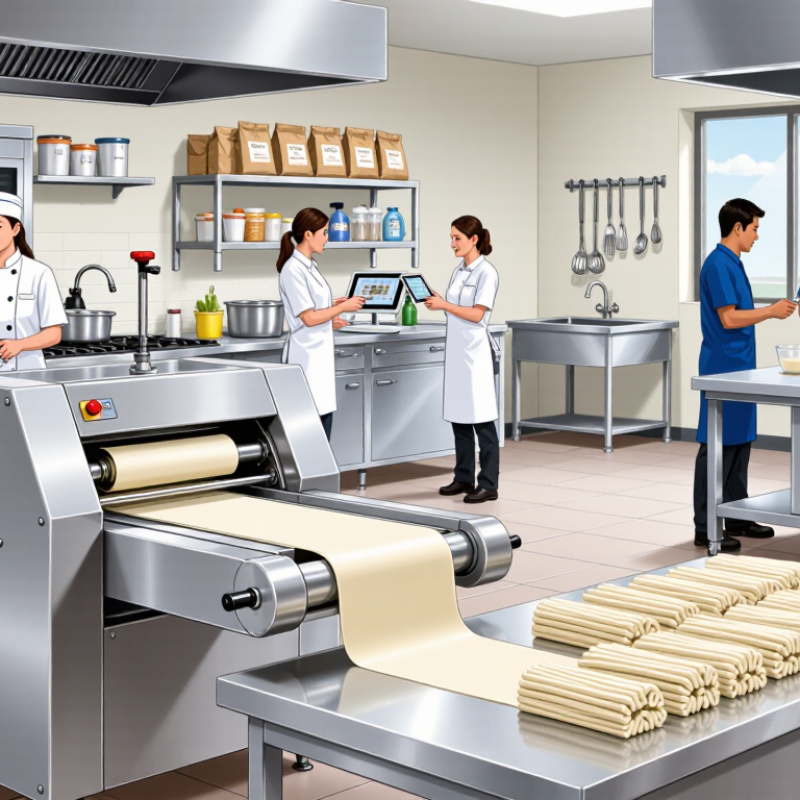
Assessing Your Business’s Udon Production Requirements
Before comparing udon machines, measure what your kitchen actually needs. Count bowls sold during a normal lunch and during your busiest service, then estimate how many noodles must be ready each hour. A shop serving 80 bowls daily may need a different setup from a kitchen preparing several hundred. Peak demand matters more than the daily average. It is easy to underestimate it.
Record your current process for one week. Note dough batches, resting time, cutting width, and staff minutes per batch. Udon dough can be firm and demanding to knead, so check whether the machine’s capacity matches your batch size—not just its headline output. Ask how quickly it can change noodle thickness, and whether cleaning parts fit your sink and routine. Small details count. A machine that runs quickly but takes too long to wash may slow the next shift.
Also consider your workspace, power supply, and the experience of the people operating it. Measure counter space, including room to feed dough and collect noodles. If demand changes by season, a very large machine could sit idle; a smaller one may create a bottleneck on busy days. There is no perfect forecast. Use sales records, staff feedback, and a realistic trial batch to refine your estimate before choosing.
Comparing Types of Udon Noodle Machines
Udon noodle machines range from hand-operated cutters to fully automatic production lines. A manual machine suits a small kitchen making limited batches. The operator rolls or feeds the dough, then cuts thick, even strands. It offers close control, but output depends heavily on skill and stamina. Slow work.
Electric sheeter-and-cutter models reduce effort without taking over every step. They can help a busy restaurant prepare fresh noodles while leaving mixing and dough resting under staff control. Check the roller width, cutting thickness, and cleaning access. Dried dough can cling around blades, especially after a long shift. That detail matters.
Automatic machines combine feeding, sheeting, and cutting, making them useful for steady, larger-volume production. Some models also portion or shape dough, but extra functions mean more settings to learn and maintain. Compare the machine’s hourly capacity with your actual peak demand, not an ideal sales estimate. A small noodle shop may not need industrial speed. And a high-capacity machine can still produce poor strands if the dough recipe or hydration is inconsistent. This comparison is not always tidy: the “best” type depends on staff experience, available space, and how often the menu changes. Before buying, test a batch using your usual flour and recipe. Watch how the noodles feed, cut, and release.
Evaluating Capacity, Automation, and Key Features
Capacity should match your busiest service window, not an average day. Estimate bowls per hour, then allow room for dough changes, refills, and cleaning. A machine’s advertised output may assume ideal conditions. Ask to run your own dough through a full cycle. Watch the texture. Noodles should stay consistent from the first batch to the last. That gap matters.
Automation can reduce repetitive work, but it does not remove the need for trained staff. Consider which steps the machine handles: mixing, sheeting, cutting, or portioning. Adjustable thickness and cutting width help you serve different noodle styles. Check how quickly settings can be changed between batches. A complicated control panel can slow a busy kitchen. Keep it practical.
Inspect the rollers, guards, and food-contact surfaces in person. Look for parts that can be removed and cleaned without special tools. Confirm the machine fits your counter, power supply, and daily workflow. Ask about maintenance intervals and replacement-part availability. A quieter machine may also make a difference in an open kitchen. I would still leave time for staff training; even a well-designed machine can produce uneven noodles when setup is rushed.
How to Choose the Best Udon Noodle Machine for Your Business — Evaluating Capacity, Automation, and Key Features
| Machine Setup | Typical Fit | Capacity to Evaluate | Automation Level | Key Features to Check | Main Trade-Off |
|---|---|---|---|---|---|
| Manual or benchtop sheeter and cutter | Restaurants, small kitchens, and businesses making limited batches | Confirm the maker’s rated dough input per hour and test whether it meets peak service demand. | Low; dough preparation, feeding, and handling are largely operator-controlled. | Roller adjustment range, cutter width options, food-contact materials, cleaning access, and available electrical supply | Lower complexity and a smaller footprint, but more labor is needed as production grows. |
| Semi-automatic sheeting and cutting system | Growing food businesses with regular production runs | Compare rated output in kilograms of dough per hour; check whether the figure includes loading, changeovers, and routine stops. | Medium; powered rolling and cutting reduce repetitive work, while operators still manage dough and transfers. | Roller gap control, cutter and thickness adjustments, dough-feed consistency, guarding, and access for sanitation | Balances labor savings with flexibility, but usually still requires hands-on process control. |
| Integrated mixing, sheeting, and cutting line | High-volume kitchens or dedicated noodle production operations | Assess the rated capacity of the complete line, not just the fastest individual machine; identify the bottleneck at each stage. | High; multiple production steps are powered or linked, with operators overseeing feeding, settings, and quality. | Mixer and sheeter compatibility, transfer method, line speed adjustment, emergency stops, guarding, and cleaning procedures | Can reduce handling between steps, but requires more floor space, coordination, and investment. |
| Modular production system with separate units | Businesses that need to scale gradually or adapt the process to different products | Match the capacity of the mixer, sheeter, cutter, and any transfer equipment; the lowest-capacity stage limits overall output. | Varies by configuration; individual modules may be manual, powered, or automated. | Module dimensions, connection requirements, changeover time, spare-part availability, and compatibility with the intended dough process | Offers flexibility and staged expansion, but separate units may require more handling and layout planning. |
| Any configuration with portioning or conveying equipment | Operations that need repeatable portions or a more organized handoff to cooking, chilling, or packing | Check portion weight consistency and the speed of the downstream station as well as noodle-making output. | Depends on whether portioning and conveying are manual, powered, or integrated. | Portion adjustment range, belt or tray compatibility, product handling, washdown suitability, and safe access | Can improve workflow consistency, but adds equipment and must be matched to the rest of the production line. |
Capacity comparison: Ask suppliers to state output in kilograms of dough per hour under clearly defined conditions. Compare figures using the same basis, and confirm performance with the dough formulation, noodle dimensions, and operating schedule you intend to use. Actual output varies by machine configuration, operator practices, changeovers, and product requirements.
Checking Build Quality, Cleaning, and Maintenance Needs
A reliable udon noodle machine should feel rigid before it enters a busy kitchen. Check the frame for wobble, inspect welds for rough seams, and open every guard or access panel. Ask whether food-contact parts can be removed without special tools. A smooth finish helps, but it does not prove the machine is easy to sanitize. A clean showroom can mislead. Look for clear cleaning instructions and documentation for materials that contact dough or water.
The CDC’s 2011 estimates report about 48 million foodborne illnesses, 128,000 hospitalizations, and 3,000 deaths each year in the United States. Those figures cover foodborne illness broadly, not noodle machines, but they underscore why sanitation details deserve attention. Check for flour traps around rollers, accessible dough scrapers, and drainage that does not leave standing water. Small details matter. A removable part may still be awkward to wash; ask to see it handled, not just listed in a manual. Confirm how often belts, blades, and seals need inspection, and whether routine service requires a technician. Keep a maintenance log with dates, replaced parts, and cleaning checks. That record can expose recurring wear before it interrupts production.
Comparing Costs, Support, and Supplier Reliability
The purchase price is only one part of an udon machine’s cost. Estimate total ownership costs, including electricity, water, cleaning time, replacement parts, and routine service. Match capacity to realistic daily demand, not a supplier’s highest production figure. A machine rated for heavy output may waste money in a small kitchen. Ask to test your own dough recipe and check noodle thickness after several batches. Small differences matter.
Support can determine how quickly production resumes after a breakdown. Ask who handles repairs, where spare parts are stored, and how long common components usually take to arrive. Get warranty coverage and exclusions in writing; rollers and cutting blades may be treated as wear items. Request a maintenance schedule with clear intervals. Keep it practical. A detailed manual is less useful if your staff cannot get a timely answer when a setting seems wrong.
Supplier reliability takes more than a polished quotation. Request references from businesses with similar output, and confirm installation, training, delivery dates, and acceptance testing before paying. Compare written specifications against the machine you inspect, including voltage, footprint, and included accessories. I would not rely on one reassuring phone call; important promises belong in the contract. It is easy to focus on price and overlook support until a part fails. Ask how the supplier handles delays, too. Their answer may be imperfect, but the details should be specific.