
Blog

China Top Parchment Paper Roll Manufacturers and Suppliers

China’s parchment paper roll market serves bakeries, food processors, retailers, and packaging distributors. Buyers often compare suppliers by price alone. That can miss important differences. Sheet consistency, release performance, roll winding, and packaging quality all affect daily use.

For this introduction, Lin Wei is an illustrative packaging-materials expert, not a cited interview source. His practical principle is: “A dependable roll is proven by consistent performance, not just a low quotation.” That distinction matters when production runs are long. A roll that unwinds smoothly and resists tearing can reduce interruptions at a busy bakery bench. Still, no single specification suits every buyer.

This guide to China’s top Parchment Paper Roll manufacturers and suppliers outlines what to examine before requesting samples or quotations. Check paper weight, width, length, core size, and surface treatment against your intended use. Ask suppliers for current product specifications and relevant quality documentation. Compare sample rolls under realistic operating conditions, including cutting and dispensing. Look closely. Minor curl or uneven winding may become costly at scale. Supplier communication also deserves attention: clear answers about customization, lead times, and packaging can indicate a more reliable purchasing relationship. These checks do not guarantee a perfect order, and sample results may differ from bulk production. That gap deserves scrutiny. A careful comparison gives buyers a stronger basis for shortlisting suppliers and asking better questions.
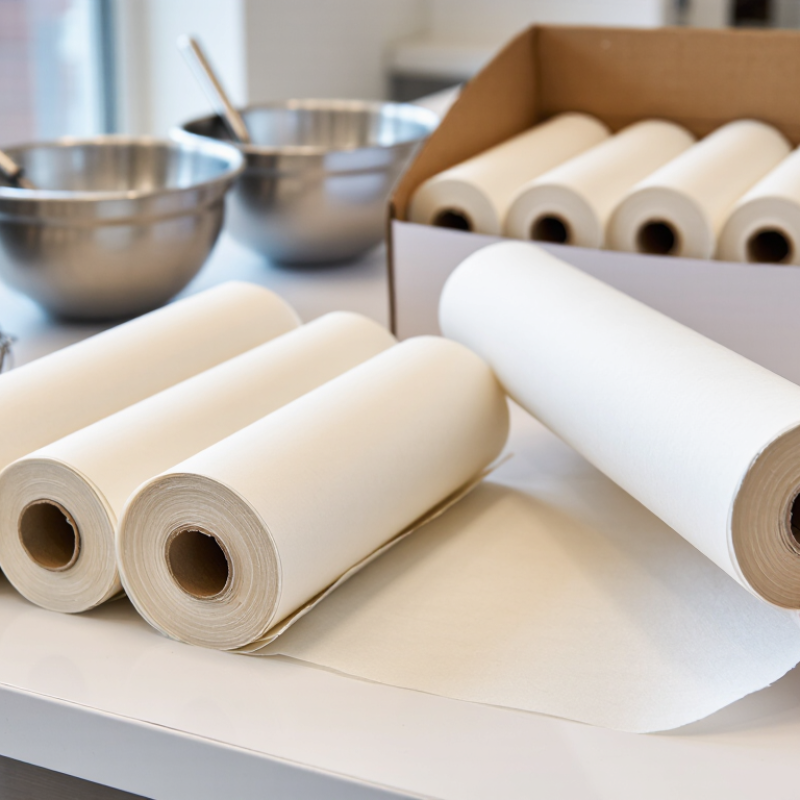
China Top Parchment Paper Roll Manufacturers and Suppliers

What Parchment Paper Rolls Are and How They Are Made

Parchment paper rolls are continuous sheets wound around a cardboard core, ready for cutting or dispensing. The name can describe different materials. True vegetable parchment starts with cellulose paper; a brief sulfuric-acid treatment swells its surface fibers, creating a dense, grease-resistant sheet. Many baking papers instead use a smooth base paper with a thin silicone release coating. That distinction matters.

Production usually begins with pulp, which is refined, formed into a wet web, pressed, and dried. For vegetable parchment, the paper passes through an acid bath, then is thoroughly washed, neutralized, and dried. Coated baking paper receives its release layer before slitting and rewinding. Operators check basis weight, thickness, coating uniformity, roll tension, and edge quality. A tiny wrinkle can become a frustrating tear at home. FAO’s Global Forest Products Facts and Figures 2022 reports roughly 401 million tonnes of global paper and paperboard production that year; this gives useful context for the scale of the fiber industry, not parchment output specifically.

Tips: Check the intended use, temperature guidance, and coating type on the product specification. For suppliers, ask for basis-weight tolerances and food-contact test documentation. Roll edges should look even, not crushed. A neat finish is useful, but it does not replace verified performance data.

China’s Parchment Paper Roll Manufacturing Landscape

China’s parchment paper roll manufacturing landscape includes paper mills, coating facilities, and converting workshops that turn large parent reels into retail or food-service sizes. Production commonly involves silicone coating, controlled drying, slitting, and rewinding. Each stage can affect release performance, sheet strength, and how smoothly a roll unwinds.

The details matter. A supplier’s sample may look clean but still unwind unevenly on a busy kitchen line. Buyers can ask about paper weight, roll width, winding tension, heat-resistance testing, and batch inspection records. Food-contact documentation and traceable material specifications also help clarify what a product is suitable for. Capabilities vary: some factories focus on high-volume standard rolls, while others handle custom widths or packaging formats. A custom order may require extra setup time.

Not every production line is equally consistent. That is worth checking. Compare samples from more than one production batch, and ask how defects are recorded and handled. The paperwork can be imperfect, too; vague test descriptions deserve follow-up questions. Clear answers about coating uniformity, core dimensions, and packaging protection offer a more useful picture of manufacturing control than a polished catalog alone.

Common Grades, Sizes, Coatings, and Applications

Parchment paper rolls are commonly specified by grade, basis weight, width, and coating. Baking grades often use bleached or natural pulp, with silicone on one or both sides for release. Many suppliers offer roughly 30–50 gsm papers and widths from 30 to 45 cm, though dimensions vary by market. Check the roll’s temperature rating and food-contact documentation, not just its weight. A heavier sheet is not automatically better. FAO’s 2022 Forest Products Yearbook reports global paper and paperboard production of about 401 million tonnes, a broad industry figure that helps explain the range of converting capacity behind specialty papers.

Coating choice should match the job. Single-sided silicone can suit tray lining; double-sided coating helps when sheets must release from both surfaces. Uncoated or grease-resistant grades may work for wrapping and food interleaving, while silicone-coated stock is often selected for baking and other release uses. Grand View Research estimated the global paper packaging market at USD 371.4 billion in 2023; that figure covers far more than parchment, so it should not be read as parchment demand. For buyers, sample testing still matters: a sheet may curl, tear, or release poorly on a particular pan. A small detail, but costly. Ask suppliers for basis-weight tolerance, roll-length tolerance, and coating-side confirmation before placing a bulk order.

China Top Parchment Paper Roll Manufacturers and Suppliers - Common Grades, Sizes, Coatings, and Applications
Product Grade or Type Typical Basis Weight Common Roll Sizes Surface or Coating Typical Applications Selection Notes
Silicone-coated baking parchment Approximately 35–60 g/m² Household formats often include 300–450 mm widths; commercial rolls commonly use wider or longer customized formats Food-contact paper with silicone release coating on one or both sides Baking cookies, pastries, bread, and other oven-baked foods; lining trays and pans Confirm whether coating is on one side or both sides, and check the product’s stated temperature limit before use.
Unbleached baking parchment Typically within the 35–60 g/m² range Commonly supplied in household widths around 300–450 mm; larger roll dimensions may be made to order Usually brown kraft-colored base paper with a non-stick release surface; coating details vary by product Home baking, food preparation, and lining baking trays “Unbleached” describes the paper’s appearance or fiber processing; it does not by itself specify the coating or heat performance.
Bleached white baking parchment Typically within the 35–60 g/m² range Retail rolls often measure about 300–450 mm wide; commercial lengths and widths vary by order White paper, commonly silicone-coated for release and non-stick performance Retail baking, bakery preparation, food presentation, and tray lining Ask the supplier to state the coating type, applicable food-contact requirements, and maximum recommended use temperature.
Vegetable parchment paper Often available in light-to-medium paper weights; exact grades depend on the intended use Available as narrow rolls and wider converting rolls; dimensions are supplier- and order-dependent Cellulose paper treated to create a dense, grease-resistant structure; it may be supplied with or without an added release coating Food wrapping, interleaving, confectionery, and selected cooking or packaging uses Vegetable parchment and silicone-coated baking parchment are related but not identical product descriptions. Verify the construction required.
Single-sided release parchment Commonly around 35–60 g/m², depending on the base paper Widths are selected to suit baking trays, packaging lines, or converting equipment Silicone release coating on one side; the reverse side may have different handling properties Tray lining, food wrapping, and applications where release is needed on one surface Check which side is coated and how the roll is wound so the release surface faces the intended direction.
Double-sided release parchment Commonly around 35–60 g/m², depending on the base paper Household and commercial widths are available; roll length is commonly customizable Silicone release coating on both sides Two-sided food contact, baking, and applications where sticking to either surface is a concern Confirm that the product is specifically rated for the intended food-contact and temperature conditions.
Commercial bakery roll Often selected from approximately 35–60 g/m² grades Commonly wider and longer than retail rolls; dimensions are matched to bakery equipment and usage volume Usually silicone-coated, with coating configuration specified to suit the application Production baking, bakery trays, food-service kitchens, and high-volume preparation Request roll width, length, core diameter, roll direction, and packaging details for equipment compatibility.
Converting or industrial master roll Grade and weight are selected for slitting, rewinding, or further processing Jumbo widths and roll diameters vary according to production capability and order requirements May be supplied coated or uncoated; coating chemistry and release level are application-specific Slitting into smaller rolls, food-paper conversion, packaging, and other downstream processing Provide target finished width, paper weight, coating side, core dimensions, and winding requirements when requesting a quotation.
Specifications shown are common market ranges and examples, not guaranteed specifications for every supplier. Actual grammage, roll dimensions, coating, food-contact status, and maximum operating temperature should be confirmed against the individual product’s technical data sheet.

How to Evaluate Chinese Manufacturers and Suppliers

Evaluating Chinese parchment paper suppliers starts with product fit, not a polished catalogue. Ask for the paper’s basis weight, roll width, core diameter, sheet tolerance, and silicone-coating details. Request a current specification sheet, then compare it with a physical sample. Check whether the paper releases cleanly from baked goods and remains stable at your actual oven temperature. Testing it in your own kitchen or production line is more useful than relying on attractive photos.

Look closely at quality controls. Ask how incoming pulp, coating uniformity, winding tension, and finished-roll defects are checked. Request batch records and food-contact documentation relevant to your destination market. Verify the issuer, scope, and validity rather than accepting a logo at face value. Confirm minimum order quantity, lead time, packaging, and how claims are handled. Ask for actual production and shipment timelines, not only best-case estimates. Small details matter.

Communication can reveal practical reliability. Send the same technical questions to several suppliers and compare how clearly they answer. A capable team should explain limitations, suggest a test plan, and flag issues such as curling, odor, or uneven release. If every answer sounds perfect, look closer. Samples may perform well while a later batch varies, so define inspection criteria and retain approved samples in writing. Price matters, but a low quote may exclude testing, stronger cartons, or consistent coating control.

How to Evaluate Chinese Parchment Paper Manufacturers and Suppliers

Suggested evaluation weights for comparing suppliers: prioritize food-contact compliance and consistent product quality, then review traceability, production capacity, and sustainability. These weights are a practical framework, not published market averages; verify applicable requirements and supplier claims for your destination market.

Ordering, Customization, Quality Checks, and Export Logistics

Ordering parchment paper rolls starts with the actual line requirements: sheet width, roll length, core diameter, basis weight, and coating type. Specify whether the paper needs grease resistance, easy release, or repeated baking performance. FAO’s 2022 Forest Products Yearbook reports roughly 401 million tonnes of global paper and paperboard production. That figure reflects a broad supply chain, not uniform quality. Request a current specification sheet and a sample from the intended production lot.

Customization should be checked against measurable criteria. Ask for basis-weight and thickness results, coating uniformity, curl limits, and release performance. Confirm that food-contact documentation matches the intended use and destination. A neat specification still misses one thing: real ovens vary. Run a trial at working temperature before approving a large order. Keep the approved sample and record its lot number.

Tips: Share carton dimensions, pallet limits, and destination port before booking. UNCTAD’s Review of Maritime Transport 2024 reported Shanghai–Europe container spot rates near $4,000 per 40-foot box in June 2024, roughly triple late-2023 levels. Rates change, but the lesson holds: confirm freight quotes, moisture protection, pallet wrapping, and shipping documents early. Small packaging details matter.