
Blog
What Are the 2026 Top Types of Copper Alloy Winding Wire?
In 2026, Copper Alloy Winding Wire will support motors, transformers, generators, and compact power electronics. Its value extends beyond electrical conductivity. Engineers must also consider tensile strength, thermal stability, fatigue resistance, corrosion behavior, and manufacturing cost. These details become visible on the production floor. A wire may survive drawing, yet fail during repeated bending or enamel curing.
Dr. David A. H. Smith, a specialist in copper-alloy conductors, observes, “The best conductor is not always the best winding wire.” This practical view guides the discussion ahead. High-conductivity copper remains important, especially where energy loss must stay low. Copper-silver alloys can retain strength at elevated temperatures. Copper-chromium-zirconium grades may suit demanding thermal cycles. Copper-magnesium and copper-tin options can improve mechanical performance. Some applications may even consider copper-clad aluminum, although it is not a conventional copper alloy. That distinction matters.
The 2026 “top” choice will depend on the winding environment, not popularity alone. A traction motor faces vibration, heat, and frequent load changes. A transformer may prioritize conductivity, insulation compatibility, and long service life. Manufacturers must also inspect surface quality, dimensional tolerance, and joint reliability. Small defects can become serious hot spots.
This overview compares the leading types of Copper Alloy Winding Wire through practical engineering criteria. It also recognizes an uncomfortable truth: no alloy performs perfectly everywhere. Data sheets can look convincing. Real production conditions are less tidy. Temperature, tooling, operator experience, and design margins can change the result. Careful validation remains essential.
What Is Copper Alloy Winding Wire?
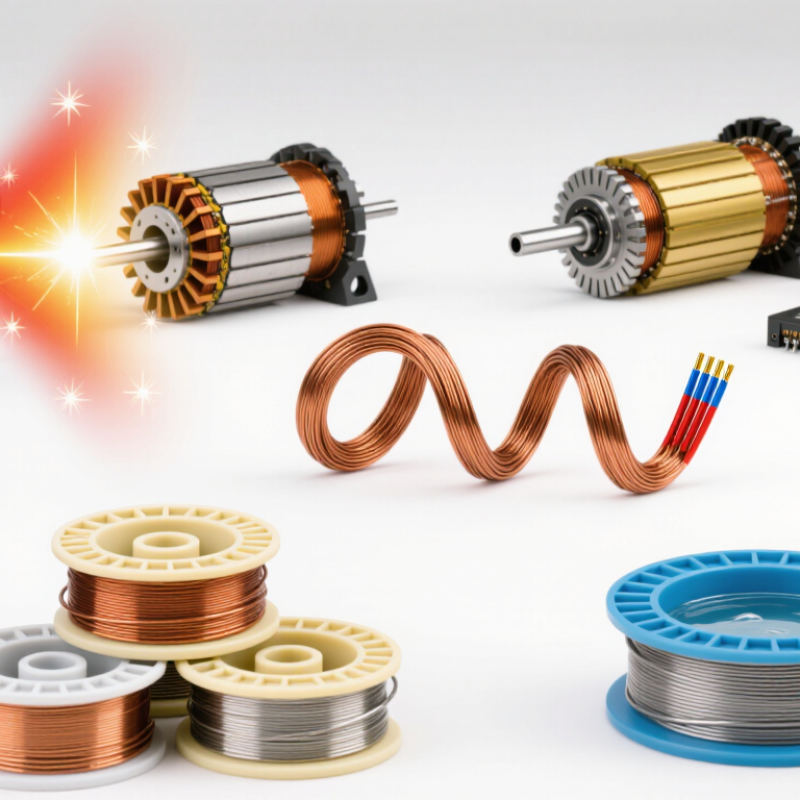
Copper alloy winding wire is an insulated conductor made from copper blended with small amounts of metals such as silver, chromium, zirconium, magnesium, or nickel. The alloy changes the wire’s strength, heat resistance, flexibility, and electrical conductivity. Unlike ordinary copper magnet wire, it may keep its shape better inside compact motor or transformer windings.
The insulation is usually an enamel coating. It separates adjacent turns and prevents short circuits under vibration or heat. IEC 60317 identifies requirements for many enamelled winding-wire types, including conductor dimensions, insulation performance, and thermal endurance. In practical production, engineers also inspect elongation, springback, surface defects, and resistance after repeated bending. Small flaws matter.
The 2025 USGS Mineral Commodity Summaries reported global mined copper production of about 23 million metric tons in 2024. The IEA’s Global Critical Minerals Outlook 2024 also identified copper as essential for electrification, including motors, grids, and renewable equipment. These figures explain why alloyed conductors are receiving more attention in 2026. Yet “copper alloy winding wire” is not one universal specification. A Cu-Ag wire may suit high-temperature strength, while Cu-Cr-Zr can support demanding thermal cycles. Nickel-bearing alloys offer different resistance and mechanical behavior. Selection still depends on current density, slot dimensions, insulation class, and manufacturing cost. A stronger alloy is not automatically better.
Which Copper Alloy Winding Wire Types Lead in 2026?
In 2026, high-purity copper winding wire remains the volume leader. It combines strong conductivity with stable drawing and reliable enamel adhesion. These properties reduce heat in compact motors. The USGS Mineral Commodity Summaries 2025 estimated global mined copper output at 22 million metric tons in 2024. Supply pressure makes material efficiency increasingly important.
Silver-bearing copper ranks highly in high-temperature motor and generator applications. It resists softening better during overload conditions. Copper-chromium-zirconium wire follows for demanding traction and industrial systems. Its strength supports repeated thermal cycling. Copper-magnesium grades also deserve attention. They offer improved mechanical strength, but usually sacrifice some conductivity. The ranking is not absolute. Actual performance depends on wire diameter, insulation, cooling, and joint quality. The IEA’s Global Critical Minerals Outlook 2024 identifies copper as essential to grids, electric vehicles, and renewable power equipment.
Tips: Match conductivity with operating temperature. Check IEC 60317 requirements and supplier test records. Ask for elongation, resistance, and softening-temperature data. Laboratory results can look excellent. Factory winding tension may tell a different story. A small process mistake still matters.
What Are the 2026 Top Types of Copper Alloy Winding Wire?
Leading copper-alloy winding-wire types by electrical performance, strength, thermal stability, and application fit
| 2026 Position | Copper Alloy Winding-Wire Type | Typical Alloying Content | Electrical Conductivity at 20°C | Typical Strength Capability | Key Technical Advantage | Main Limitations | Common Winding Applications | 2026 Lead Role |
|---|---|---|---|---|---|---|---|---|
| 1 | Copper–Silver (CuAg) Silver-bearing copper wire | Approximately 0.05–0.25% silver; balance copper | Approximately 95–101% IACS, depending on silver level and processing | Higher creep resistance and strength retention than commercially pure copper; hard-drawn wire can provide substantially higher tensile strength than annealed wire | Maintains high conductivity while improving softening resistance and dimensional stability at elevated temperature | Higher material cost than pure copper; the conductivity benefit is smaller than the cost increase at low silver additions | High-speed motors, traction machines, generators, aerospace electrical systems, and high-temperature electromagnetic windings | Best high-conductivity upgrade |
| 2 | Copper–Chromium–Zirconium (CuCrZr) Precipitation-hardening copper alloy | Typically about 0.5–1.2% chromium and 0.03–0.30% zirconium; balance copper | Approximately 75–85% IACS after suitable heat treatment | Commonly about 450–700 MPa for strengthened wire, with strong resistance to softening at elevated temperature | Excellent combination of conductivity, mechanical strength, wear resistance, and thermal stability | Lower conductivity than CuAg or high-purity copper; heat treatment and processing control are important | High-current motor windings, resistance-welding equipment, generator components, demanding industrial coils, and compact electrical machines | Best strength–conductivity balance |
| 3 | Copper–Nickel–Silicon (CuNiSi) Age-hardenable copper alloy | Usually about 1–4% nickel and 0.5–2% silicon; exact composition varies by grade | Approximately 30–60% IACS, depending on composition and temper | Often about 600–900 MPa in precipitation-hardened conditions | High tensile strength, good fatigue resistance, and strong resistance to stress relaxation | Significantly lower conductivity than copper–silver alloys; requires controlled aging treatment for maximum performance | High-stress coils, compact motors, spring-like electrical contacts integrated into winding systems, and vibration-prone assemblies | Best for high mechanical loading |
| 4 | Low-Tin Copper (CuSn0.1–CuSn0.3) Lightly alloyed tin copper | Approximately 0.1–0.3% tin; balance copper | Approximately 80–95% IACS, depending on tin content and processing | Moderately higher strength and improved softening resistance than pure copper | Improved resistance to thermal softening and creep with relatively small conductivity loss | Not as strong as CuCrZr or CuNiSi; conductivity decreases as tin content rises | Automotive and industrial motor windings, elevated-temperature coils, and applications requiring a practical balance of cost and durability | Best practical upgrade for general windings |
| 5 | Higher-Tin Copper / Phosphor Bronze (CuSn4–CuSn8) Tin-rich copper alloy wire | Approximately 4–8% tin; some grades may include a small phosphorus addition | Typically about 13–45% IACS, depending on tin level and metallurgical condition | Often about 450–800 MPa, with good fatigue strength and spring characteristics | High strength, good fatigue resistance, and good resistance to corrosion and stress relaxation | Substantially lower conductivity and higher resistive heating than high-conductivity copper alloys | Specialized sensor coils, spring-loaded electromagnetic components, small actuators, control devices, and low-current windings | Specialist high-strength option |
| 6 | Copper–Tellurium (CuTe) Free-machining copper alloy | Approximately 0.4–0.7% tellurium; balance copper | Approximately 85–95% IACS | Moderate strength; valued more for manufacturability than for maximum tensile performance | Excellent machinability while retaining relatively high electrical conductivity | Not generally selected for the highest-strength or highest-temperature winding duty; tellurium content requires appropriate recycling and process controls | Machined electromagnetic components, formed terminals, specialized coils, and assemblies where machining efficiency is important | Best for manufacturability |
Technical note: Conductivity values are indicative ranges expressed as a percentage of the International Annealed Copper Standard (IACS) at 20°C. Tensile strength and thermal behavior depend on alloy composition, wire diameter, drawing reduction, heat treatment, temper, and insulation system. The ranking reflects technical relevance and application breadth for 2026 rather than company sales or market-share data.
How Do Their Electrical and Mechanical Properties Compare?
What Are the 2026 Top Types of Copper Alloy Winding Wire?
Copper alloy winding wire is selected by balancing conductivity, heat resistance, strength, and flexibility. Pure copper carries current efficiently, but it can soften under continuous heat and vibration. Copper-silver wire usually retains high conductivity while resisting softening during overloads. It suits compact motors, transformers, and high-temperature coils.
Copper-chromium-zirconium wire offers greater tensile strength and improved resistance to creep. Its conductivity is lower than pure copper, often around 75–85% IACS, depending on composition and processing. Copper-magnesium wire provides strong mechanical performance and good fatigue resistance. However, its higher electrical resistance can increase heat generation in tightly packed windings. Copper-tin wire is easier to form and resists wear, but it sacrifices more conductivity.
The difference becomes obvious during testing. A softer wire bends around small coil corners with fewer cracks. A harder alloy holds its shape better after winding, especially under electromagnetic forces. Enamel adhesion, elongation, and springback also matter. They are easy to overlook. In production, engineers should measure resistance at operating temperature, not only at room temperature. A useful comparison includes tensile strength, elongation, repeated-bend performance, and insulation breakdown voltage. No alloy wins every test. A specification that looks excellent electrically may create difficult winding tension or reduced flexibility. Processing quality can also change results, so sample testing remains essential.
Where Are Different Copper Alloy Wires Commonly Used?
Copper alloy winding wire is chosen according to heat, vibration, current, and space. Pure copper remains common in household motors, transformers, and industrial generators. Copper-silver wire performs well in high-temperature motors and compact aerospace equipment. Its strength stays useful when windings face repeated heating cycles.
Copper-chromium and copper-chromium-zirconium wires serve demanding motor applications. They fit traction motors, electric vehicle drive units, and high-load industrial machines. These alloys resist softening better than ordinary copper. Copper-tin wire is often used where vibration and mechanical stress are serious concerns. It can support windings in pumps, compressors, and transport equipment. Small details matter. Enamel thickness also affects slot filling and insulation life.
Copper-nickel wire is useful in precision coils, sensors, and controlled-resistance windings. Some heating and measurement assemblies need stable electrical behavior rather than maximum conductivity. In practical manufacturing, engineers check current density, operating temperature, bend radius, and connection methods together. A stronger alloy is not automatically the better choice. It may reduce conductivity or complicate winding.
I have seen designs focus on tensile strength while overlooking heat dissipation. That mistake can shorten service life. Test data from the finished coil should guide the final selection.
How Should the Right Winding Wire Type Be Selected?
What Are the 2026 Top Types of Copper Alloy Winding Wire?
Selecting winding wire should begin with the motor’s actual working conditions, not a catalog label. Common 2026 choices include enamelled round wire, rectangular wire, self-bonding wire, and high-temperature wire. Round wire suits general motors and transformers. Rectangular wire improves slot filling in compact, high-power motors. Self-bonding wire can reduce movement and noise. High-temperature insulation supports demanding thermal cycles.
The International Energy Agency’s Global EV Outlook 2024 reported more than 14 million electric cars sold worldwide in 2023. That growth increases demand for efficient traction motors. The report also shows copper remains important in electrification systems. Meanwhile, the International Copper Study Group forecast continued refined copper demand growth in 2025. Therefore, conductor size matters, but insulation class, flexibility, thermal aging, and voltage stress deserve equal attention. Conductivity alone is not enough. A higher temperature rating is not automatically better. It may raise cost without improving service life.
Tips: Match wire diameter with slot space and current density. Check IEC 60317 or equivalent insulation requirements. Request thermal-aging evidence, elongation data, and breakdown-voltage results. For high-speed rotors, examine centrifugal strength carefully. Small design errors can create large hot spots. In practice, engineers sometimes over-specify wire. That choice feels safe, but it can reduce efficiency and complicate winding. A controlled prototype test is often wiser than a perfect-looking specification.