
Blog

What Are the 2026 Best Commercial Wall Lights for Buyers?

Choosing the 2026 best Commercial Wall Lights requires more than comparing brightness, finishes, or online prices. Buyers must examine how each fixture performs beside a hotel entrance, along a retail corridor, or above a damp restaurant terrace. A wall light can look impressive in a product photograph and still create harsh glare on a customer’s face.

Richard Kelly, a pioneering architectural lighting designer, wrote, “Light is the only thing that makes architecture visible.” His observation remains useful for commercial buyers. The right fixture should reveal textures, guide movement, support safety, and strengthen a building’s identity without overwhelming its architecture. Look closely at beam angle, color temperature, lumen output, shielding, dimming compatibility, and ingress protection. These details matter after installation, not only during specification.

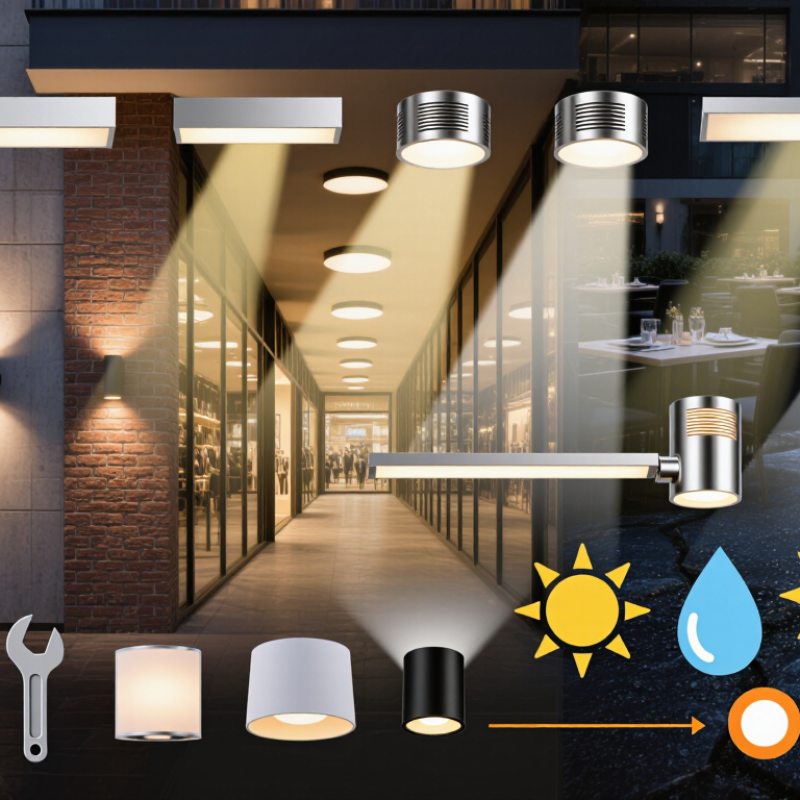
This guide examines Commercial Wall Lights through a practical buyer’s lens. It considers LED efficiency, weather resistance, maintenance access, mounting stability, and visual comfort. It also compares styles, including up-and-down lights, recessed wall fixtures, surface-mounted cylinders, and decorative exterior sconces. Small differences become obvious at night. A narrow beam may highlight brick beautifully, while a poorly aimed fitting can spill light into neighboring windows.

No checklist is perfect. That matters. Site conditions, local standards, and user expectations can change the final decision. Buyers should request photometric data, verify warranty terms, and test samples whenever possible. The best fixture is not always the brightest or most expensive. It is the one that remains reliable, comfortable, and visually appropriate after months of real commercial use.
What Are the 2026 Best Commercial Wall Lights for Buyers?

Commercial Wall Light Types: LED, Sconce, Bulkhead, and Area-Lighting Designs

Commercial wall lights in 2026 need more than high brightness. Buyers should match each type to its working environment.

LED wall lights provide efficient, even illumination for corridors, loading entrances, and service areas. Look for clear lumen data, color temperature, glare control, and replaceable drivers. A 3000K to 4000K range often keeps surfaces readable without making staff feel exposed. Inspect the surface. In site reviews, I have seen efficient fixtures fail when heat collects behind sealed panels.

Sconces suit hotels, offices, and retail exteriors where appearance matters beside directional light. Their shades can soften faces, but decorative forms may trap dust or complicate cleaning. Inspect the IP rating, lens access, and wiring space before purchasing.

Bulkhead lights are practical for workshops, parking structures, stairwells, and coastal service zones. Choose impact-resistant housings and sealed gaskets where moisture, grit, or accidental contact is likely. Rugged is not always comfortable. A harsh lens can create dark steps and distracting reflections.

Area-lighting wall designs spread illumination across yards, paths, and building perimeters. They work best when beam angle, mounting height, and nearby windows are assessed together. Photocells, occupancy controls, and dimming can reduce wasted energy, but controls require commissioning. Ask for photometric files and warranty terms, not only attractive catalog photographs. Accessible terminals, corrosion-resistant fasteners, and temperature-rated drivers also matter. Test one sample. Real walls often expose assumptions.

2026 Performance Benchmarks: 100–150 lm/W, 80+ CRI, and 50,000-Hour Life

What Are the 2026 Best Commercial Wall Lights for Buyers?

For 2026, commercial wall lights should deliver 100–150 lumens per watt at the complete fixture level. This figure includes optics, housing, driver losses, and thermal effects. The U.S. Department of Energy’s solid-state lighting reports identify higher efficacy as a major development target. However, advertised chip efficiency can mislead buyers. Request an independent LM-79 photometric report before comparing products.

Color quality matters in corridors, hotels, offices, and retail areas. A minimum CRI of 80 supports acceptable everyday appearance, while 90 or higher may suit hospitality and display environments. The Illuminating Engineering Society’s testing methods separate measured color performance from marketing claims. Check R9 performance when skin tones, wood, and warm finishes must look natural. Small differences become obvious under bright wall illumination.

Fifty thousand operating hours remains a practical 2026 benchmark. At twelve hours daily, that equals about eleven years of service. Yet lifetime depends on temperature, driver quality, switching cycles, and installation conditions. The DesignLights Consortium technical requirements emphasize verified performance rather than simple lifetime statements. Ask whether the rating means L70, and review LM-80 and TM-21 data where available. A hot, enclosed wall light may fail earlier. That risk is easy to underestimate. In field inspections, uneven brightness often appears before total failure, making thermal design and lumen maintenance worth checking.

Selecting IP65–IP66 Ratings for Commercial Outdoor Wall-Light Protection

In 2026, the best commercial wall lights are not judged by appearance alone.

Outdoor protection matters more when fixtures face rain, dust, vehicle spray, and daily cleaning. For most exposed façades, IP65 offers dust-tight protection and resistance to water jets. IP66 provides stronger protection against powerful water jets. Neither rating means the fixture can remain underwater.

Look beyond the printed IP number. Check the test standard, certification details, cable glands, gaskets, and installation instructions. A well-sealed housing can still fail if the cable entry points are loose.

Stainless fasteners, UV-resistant lenses, and corrosion-resistant finishes also deserve attention near coastal sites or busy roads. Temperature ratings matter too, especially where lights operate overnight in enclosed mounting spaces.

Site experience often reveals small weaknesses. Water may collect above a wall light, then run behind the mounting plate. Dust can enter during careless wiring. A qualified installer should keep drainage paths clear and tighten every connection correctly. Local electrical requirements must also guide the installation.

IP66 sounds better, but it may add cost without offering useful benefits in a sheltered corridor. That is an easy mistake. Review the exposure, cleaning routine, mounting height, and maintenance access before choosing the rating. Test reports should match the complete fixture, not only an individual housing component.

Evaluating DLC, ENERGY STAR, Controls, and Commercial Energy Savings

What Are the 2026 Best Commercial Wall Lights for Buyers?

For 2026, the strongest commercial wall lights should prove more than attractive illumination. They should combine DLC qualification, reliable controls, and measurable energy performance. The DLC Technical Requirements evaluate efficacy, light distribution, color quality, and controllability. These details matter beside a loading dock, where glare can hide uneven pavement. ENERGY STAR guidance reports that certified LED lighting can use up to 90% less energy than incandescent lighting and last much longer. However, ENERGY STAR coverage varies by product category, so buyers must verify the exact fixture type.

ENERGY STAR guidance reports that certified LED lighting can use up to 90% less energy than incandescent lighting and last much longer.

Commercial lighting deserves serious attention. The U.S. Energy Information Administration’s 2018 Commercial Buildings Energy Consumption Survey shows lighting represents roughly 17% of commercial building electricity use. Occupancy sensors, daylight dimming, and scheduled controls can reduce waste in corridors, entrances, and service areas. Department of Energy guidance indicates controls may deliver approximately 20% to 50% lighting-energy savings, depending on operating patterns and installation quality. That range is broad.

Look for dimming compatibility, sensor placement, emergency-lighting requirements, and documented lumen maintenance. A DLC listing is useful, but it does not guarantee perfect installation results.

I still question optimistic payback claims when commissioning is ignored. Record baseline wattage, operating hours, and nighttime illumination before purchasing. Then compare measured results after installation. Small errors matter. A poorly aimed wall light can create glare, complaints, and unnecessary relamping, even when its specifications look excellent.

Comparing Mounting, Beam Angles, Color Temperatures, and Warranty Terms

Commercial wall lights in 2026 should be judged by installation conditions, not appearance alone. In site audits, I check the junction box, wall material, service access, and mounting height first. Direct mounting suits solid masonry and reduces visible hardware. A backplate system works better on uneven surfaces. Adjustable brackets help aim light around signs, doors, and pedestrian routes. Mounting matters.

Beam angle controls both comfort and coverage. Narrow beams create strong accents near entrances, but they can produce bright spots on textured walls. Wider beams spread light across corridors and façades. The Illuminating Engineering Society recommends evaluating uniformity, glare, and maintained illuminance together, rather than choosing fixtures by lumen output alone. A practical test uses a temporary fixture at night. Photometric files cannot fully show reflections from brick or wet pavement.

Color temperature should match the building’s use. Around 3000K often feels calmer for hospitality areas, while 3500K to 4000K can support retail visibility and security perception. The U.S. Department of Energy’s Solid-State Lighting R&D report identifies efficacy, color quality, and controls as major commercial LED priorities. Look for published CRI and TM-30 data, not vague “natural white” claims. The DesignLights Consortium SSL Technical Requirements specify five-year warranty coverage for qualifying products. Buyers should verify what the warranty covers, including drivers, finish failure, labor, and lumen depreciation. Some terms sound strong but exclude installation costs. That deserves scrutiny.